eMaths.ie
  • Home
    • Contact
    • Revision Notes
    • 150 HL Revision Questions
    • Exam Layout
    • T&T Solutions
    • Calculators
    • Geogebra
    • Formulae and Tables Book
    • Applied Maths
    • Projectmaths.ie
  • HL Paper 1
    • Algebra 1
    • Algebra 2
    • Algebra 3
    • Financial Maths
    • Algebra Overview
    • Proof by Induction
    • Functions
    • Graphing Polynomials
    • Differentiation
    • Integration
    • Sequences & Series
    • Arithmetic and Money
    • Number Systems
    • Complex Numbers
    • Paper 1 - Must Learn
  • HL Paper 2
    • The Line
    • Probability
    • Statistics
    • Geometry
    • Area and Volume
    • The Circle
    • Trigonometry Overview
    • Trigonometry 1
    • Trigonometry 2
    • Paper 2 - Must Learn
  • HL Exam Papers
    • Printable Exam Questions
    • Exam Question Solutions & Marks
    • Molloy Maths LCHL Exam Videos
    • Revision Questions
  • OL Topics
    • OL Algebra
    • OL Complex Numbers
    • OL Calculus
    • OL Normal Curve and Hypothesis Testing
    • OL Statistics
    • OL Probability
    • OL Area & Volume
    • OL Trigonometry
    • OL Circle

Algebra 3

Picture
  • Inequalities use symbols such as \(>\), \(\ge\), \(<\), \(\le\) to describe ranges of values that satisfy a condition.
  • Basic rules:
    • Adding or subtracting the same number on both sides leaves the inequality unchanged.
    • Multiplying or dividing both sides by a positive number preserves the direction.
    • Multiplying or dividing by a negative number reverses the direction.
  • Solutions can be expressed in interval notation or shown on a number line.
  • Compound (double) inequalities, e.g. \(-2 < x \le 5\), describe continuous ranges.
  • Graphical and algebraic methods are used to determine solution sets efficiently.

Solving Linear Inequalities

Example 1: Solve \(3x+7\ge x+2,\; x\in\mathbb Z\), and plot the solution on a number line.

Example 2: Solve \(\tfrac16(x-1)\ge\tfrac13(x-4),\; x\in\mathbb R\), and graph your solution.

Example 3: Solve \(-9<3-4x\le1,\; x\in\mathbb R\), and graph your solution.

Example 4:
(i) Find \(A=\{x\mid 7\le 10-3x,\; x\in\mathbb R\}\).
(ii) Find \(B=\{x\mid 2>\tfrac43-2x,\; x\in\mathbb R\}\).
(iii) Find \(A\cap B\) and graph the solution on the number line.
Show video
Show worked solutions
Example 1
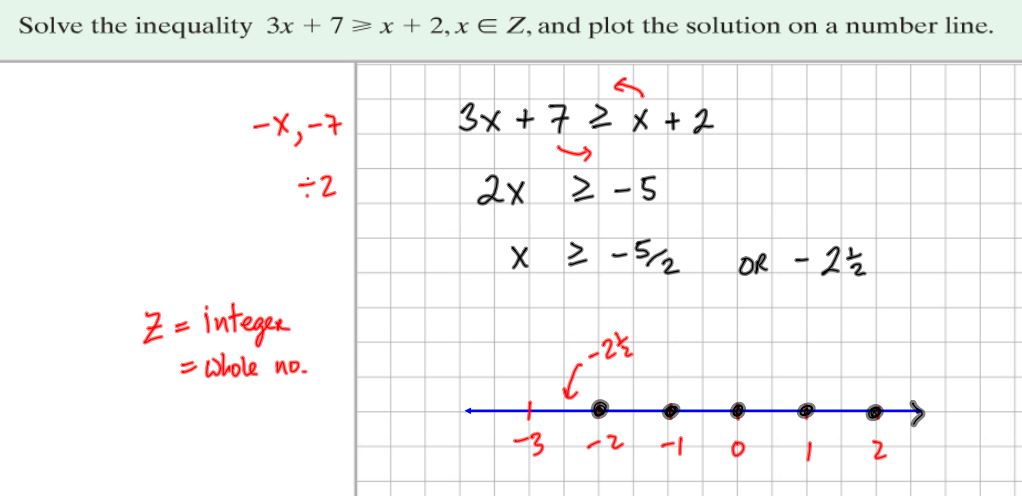
\(3x+7\ge x+2 \;\Rightarrow\; 2x\ge -5\)
\(x\ge -\tfrac52\). For integers, \(x\in\mathbb Z\Rightarrow x\ge -2\).
Solution set: \(\{x\in\mathbb Z\mid x\ge -2\}\).
Example 2
Multiply by \(6>0\): \(x-1\ge 2(x-4)=2x-8\)
\(-1\ge x-8 \;\Rightarrow\; 7\ge x\)
Solution set: \((-\infty,\,7]\).
Example 3
\(-9<3-4x\le 1\)
Subtract \(3\): \(-12<-4x\le -2\)
Divide by \(-4\) (reverse signs): \(3>x\ge \tfrac12\)
Hence: \(\tfrac12\le x<3\).
Example 4
(i) \(7\le 10-3x \Rightarrow -3\le -3x \Rightarrow 1\ge x\), so \(A=(-\infty,\,1]\).
(ii) \(2>\tfrac43-2x \Rightarrow 2-\tfrac43>-2x \Rightarrow \tfrac23>-2x \Rightarrow x> -\tfrac13\), so \(B=(-\tfrac13,\,\infty)\).
(iii) \(A\cap B=(-\tfrac13,\,1]\).

Inequalities — Interactive Questions

Q1: Solve the inequality \(3x + 7 > x + 2\), \(x \in \mathbb{R}\). ▼

Solution.

\[ 3x + 7 > x + 2 \;\Rightarrow\; 2x > -5 \;\Rightarrow\; x > -\tfrac{5}{2}. \]

Hence, \(\boxed{x > -2.5}\).

Q2: Solve the inequality \(\tfrac{1}{6}(x-1) > \tfrac{1}{3}(x-4)\), \(x \in \mathbb{R}\). ▼

Solution.

Multiply through by \(6\) (positive):

\[ x - 1 > 2(x - 4) \;\Rightarrow\; x - 1 > 2x - 8 \;\Rightarrow\; -1 + 8 > x \;\Rightarrow\; x < 7. \]

Thus, \(\boxed{x < 7}\).

Q3: Solve the compound inequality \(-9 < 3 - 4x < 1\), \(x \in \mathbb{R}\). ▼

Solution.

Subtract \(3\) from each part:

\[ -12 < -4x < -2. \]

Divide through by \(-4\) (reverse the inequality signs):

\[ 3 > x > \tfrac{1}{2} \;\;\Rightarrow\;\; \boxed{\tfrac{1}{2} < x < 3}. \]

Inequalities Video Tutorials

Solve the inequality \(\;3x + 7 \ge x + 2,\; x \in \mathbb{Z}\;\) and plot the solution on a number line.

Worked solution and number line for 3x + 7 ≥ x + 2, x ∈ Z

Find the set of values for which \(\,3(x - 2) > x - 4\,\) and \(\,4x + 12 > 2x + 17,\; x \in \mathbb{R},\) and plot your answers on a number line.

Worked solution and number line for inequalities 3(x−2)>x−4 and 4x+12>2x+17, x∈R.
  • Write the inequality in the form \(ax^{2}+bx+c \ \,\square\,\ 0\) where \(\square \in \{<, \le, >, \ge\}\).
  • Find the critical values by solving \(ax^{2}+bx+c=0\) (by factorising, completing the square, or the quadratic formula).
  • Use a sign chart or a sketch of the parabola \(y=ax^{2}+bx+c\):
    • If \(a>0\) (opens upward): the quadratic is positive outside the roots and negative between the roots.
    • If \(a<0\) (opens downward): the quadratic is negative outside the roots and positive between the roots.
  • Include endpoints when the inequality is non-strict (\(\le\) or \(\ge\)); exclude them for strict inequalities (\(<\) or \(>\)).
  • If the discriminant is negative (\(\Delta<0\)):
    • For \(a>0\): \(ax^{2}+bx+c>0\) for all \(x\); \(ax^{2}+bx+c<0\) has no real solution.
    • For \(a<0\): \(ax^{2}+bx+c<0\) for all \(x\); \(ax^{2}+bx+c>0\) has no real solution.
  • If there is a repeated root (\(\Delta=0\)), the quadratic touches the axis once; for strict inequalities the single point is excluded, for non-strict it is included.
  • Avoid multiplying both sides by an expression in \(x\). Instead, keep one side \(0\) and reason from the sign of \(ax^{2}+bx+c\).
Quadratic Inequalities Video Tutorial

Solve the inequality \(\;12 - 5x - 2x^2 > 0\;\).

Worked solution and number line for the quadratic inequality 12 - 5x - 2x² > 0.

Solve \(\,\dfrac{2x-7}{x+3} < 1,\; x \ne -3\,\).

Worked solution for (2x−7)/(x+3) < 1, x ≠ −3.
  • \(|x|\) is the distance of \(x\) from \(0\): \[ |x|=\begin{cases} x,&x\ge0\\ -x,&x<0 \end{cases} \]
  • To solve \(|ax+b|=k\) (\(k\ge0\)): solve \(ax+b=k\) or \(ax+b=-k\).
  • \(|ax+b|
  • \(|ax+b|>k \Rightarrow ax+b>k\) or \(ax+b<-k\)\, (two rays).
  • When both sides contain moduli, square both sides (non-negative) or use identities — always verify solutions.
Q1: Solve \(\lvert 2x-5\rvert = 7\) for \(x\in\mathbb{R}\). ▼

Solution. \(\lvert 2x-5\rvert=7 \iff 2x-5=7\) or \(2x-5=-7\).

\[ 2x=12 \Rightarrow x=6;\qquad 2x=-2 \Rightarrow x=-1. \]

Hence, \(\boxed{x\in\{-1,6\}}.\)

Q2: Solve \(\lvert x+3\rvert < 5\) for \(x\in\mathbb{R}\). ▼

Solution. \(\lvert x+3\rvert<5 \iff -5

\[ -8

Hence, \(\boxed{x\in(-8,2)}.\)

Q3: Solve \(\lvert 2x+1\rvert \ge \lvert x-4\rvert\) for \(x\in\mathbb{R}\). ▼

Solution. Both sides are non-negative; square:

\[ (2x+1)^2 \ge (x-4)^2. \]

Difference of squares:

\[ \big[(2x+1)-(x-4)\big]\big[(2x+1)+(x-4)\big] \ge 0 \;\Rightarrow\; (x+5)(3x-3)\ge 0. \]

Critical points: \(-5\) and \(1\). Sign analysis \(\Rightarrow (-\infty,-5]\cup[1,\infty)\).

Therefore, \(\boxed{x\le -5\ \text{ or }\ x\ge 1}.\)

Modulus functions, equations and inequalities tutorial videos
  • A mathematical proof is a logical argument demonstrating that a statement holds for all cases, using definitions, prior results, and valid reasoning.
  • Common methods:
    • Direct proof: deduce the conclusion from assumptions via algebra and definitions.
    • Contradiction: assume the negation of the claim and derive an impossibility.
    • Induction: prove a base case and an inductive step to establish truth for all \(n\in\mathbb{N}\).
  • Good proofs state assumptions, proceed in clear logical steps, and end with a justified conclusion.
  • Useful symbols: \(\Rightarrow\) (implies), \(\Leftrightarrow\) (iff), \(\therefore\) (therefore), Q.E.D.
Section 12.4 — Mathematical Proof: Summary ▼
  • A mathematical proof is a logical argument showing that a statement is always true using accepted facts and reasoning.
  • Common methods:
    • Direct proof — apply definitions and algebra to show a result follows directly.
    • Proof by contradiction — assume the opposite of what you want to prove and find a contradiction.
    • Proof by induction — used to prove statements for all positive integers.
  • Each proof should clearly show assumptions, logical steps, and a conclusion.
  • Symbols such as “⇒”, “⇔”, “∴”, and “Q.E.D.” denote logical flow and completion.

Mathematical Proof — Interactive Questions

Q1: Prove that if \(n\) is even, then \(n^{2}\) is also even. ▼

Solution — Direct Proof.

\[ n=2k\text{ for some integer }k \;\Rightarrow\; n^{2}=(2k)^{2}=4k^{2}=2(2k^{2}). \]

Since \(2k^{2}\) is an integer, \(n^{2}\) is even. ∴ proved.

Q2: Prove by contradiction that \(\sqrt{2}\) is irrational. ▼

Solution — Proof by Contradiction.

Assume \(\sqrt{2}\) is rational ⇒ \(\sqrt{2}=\tfrac{p}{q}\) in lowest terms (\(p,q\in\mathbb{Z}, q\ne0\)).

\[ 2=\frac{p^{2}}{q^{2}}\;\Rightarrow\;p^{2}=2q^{2}. \]

Then \(p^{2}\) even ⇒ \(p\) even ⇒ \(p=2k\). Substitute: \(4k^{2}=2q^{2}\Rightarrow q^{2}=2k^{2}\Rightarrow q\) even. Hence both \(p\) and \(q\) even ⇒ contradiction (not in lowest terms). ∴ \(\sqrt{2}\) is irrational.

Picture
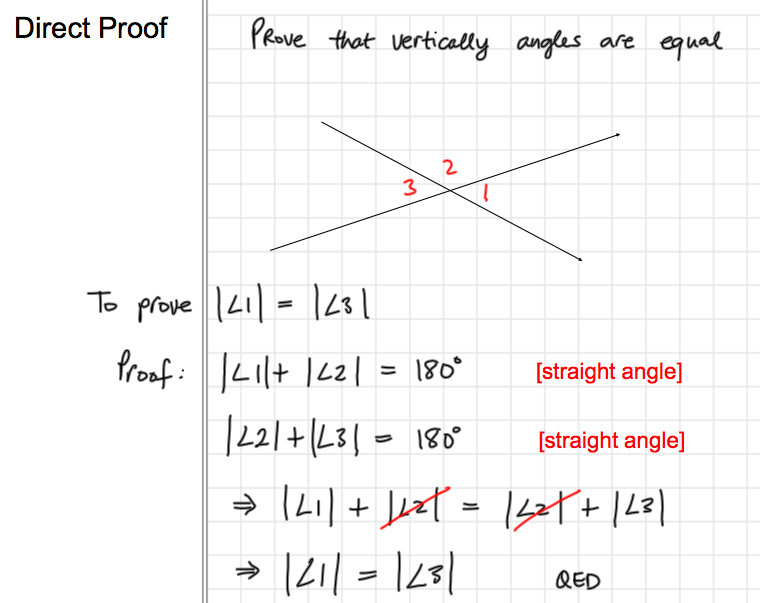
Simple Example of Direct Proof
Picture
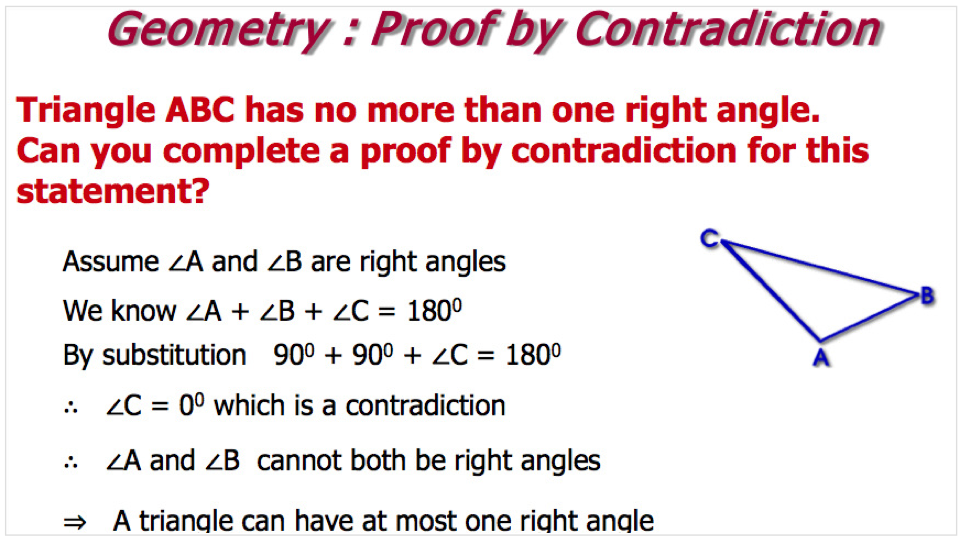
Simple proof by contradiction
Picture
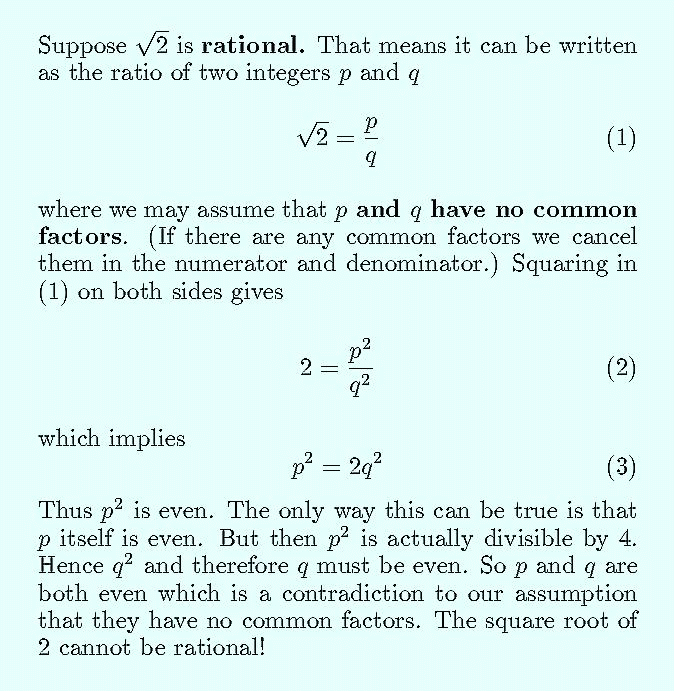
Proof root is irrational by contradiction (this is mentioned in the syllabus!)
Section 12.5 — Proof of Abstract Inequalities: Summary ▼
  • Common proof strategies for inequalities include:
    • Using non-negativity of squares, e.g. \((x-y)^{2}\ge 0\).
    • Completing the square to compare expressions.
    • Applying standard results such as the AM–GM or triangle inequalities.
  • AM–GM (Arithmetic Mean–Geometric Mean Inequality):
    For non-negative numbers \(x,y\), \[ \frac{x+y}{2} \ge \sqrt{xy}, \] with equality only when \(x=y\). It states that the arithmetic mean of two (or more) non-negative numbers is always at least as great as their geometric mean.
  • When proving inequalities, clearly identify when equality holds and specify any domain restrictions (e.g. \(x,y\ge0\)).

Abstract Inequalities — Interactive Questions

Q1: For real \(a,b\), prove that \(a^{2}+b^{2}\ge 2ab\). State the equality condition. ▼

Solution.

\[ (a-b)^{2}\ge 0 \;\Rightarrow\; a^{2}-2ab+b^{2}\ge 0 \;\Rightarrow\; a^{2}+b^{2}\ge 2ab. \]

Equality holds iff \((a-b)^{2}=0\), i.e. \(\boxed{a=b}\).

Q2: For \(x,y\ge 0\), prove the AM–GM inequality \(\displaystyle \frac{x+y}{2}\ge \sqrt{xy}\). State when equality holds. ▼

Solution.

Start with a non-negative square: \((\sqrt{x}-\sqrt{y})^{2}\ge 0\).

\[ x-2\sqrt{xy}+y\ge 0 \;\Rightarrow\; x+y\ge 2\sqrt{xy} \;\Rightarrow\; \frac{x+y}{2}\ge \sqrt{xy}. \]

Equality occurs when \(\sqrt{x}=\sqrt{y}\), i.e. \(\boxed{x=y}\).

Q3: For real \(a,b\), prove the triangle inequality \(\lvert a+b\rvert\le \lvert a\rvert+\lvert b\rvert\). ▼

Solution.

Square both sides (non-negative quantities):

\[ \lvert a+b\rvert^{2}=(a+b)^{2}=a^{2}+2ab+b^{2} \le a^{2}+2\lvert a\rvert\lvert b\rvert+b^{2} =(\lvert a\rvert+\lvert b\rvert)^{2}. \]

Taking square roots gives \(\lvert a+b\rvert\le \lvert a\rvert+\lvert b\rvert.\)

Equality holds when \(a,b\) have the same sign (or one is zero).

Video Tutorial
Section 12.6 — Indices (Laws of Indices & Exponents): Summary ▼
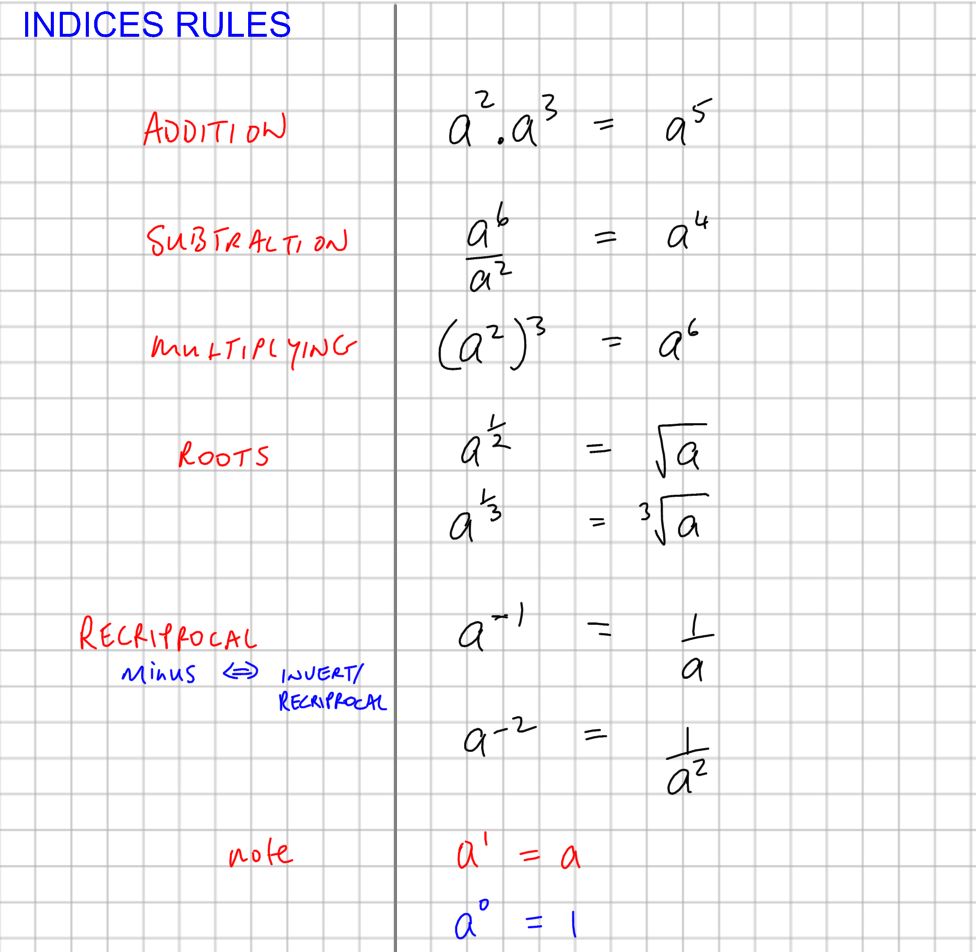
  • Indices (or exponents/powers) indicate repeated multiplication: \[ a^{n} = \underbrace{a\times a\times\cdots\times a}_{n\text{ times}}. \]
  • Index Laws (for \(a,b\ne0\), \(m,n\in\mathbb{R}\)):
    • \(a^{m}\,a^{n}=a^{m+n}\)
    • \(\dfrac{a^{m}}{a^{n}}=a^{m-n}\)
    • \((a^{m})^{n}=a^{mn}\)
    • \((ab)^{n}=a^{n}b^{n}\)
    • \(\left(\dfrac{a}{b}\right)^{n}=\dfrac{a^{n}}{b^{n}}\)
    • \(a^{0}=1\) (for \(a\ne0\))
    • \(a^{-n}=\dfrac{1}{a^{n}}\)
    • \(a^{\tfrac{1}{n}}=\sqrt[n]{a}\), so \(a^{\tfrac{m}{n}}=(\sqrt[n]{a})^{m}\).
  • Indices follow the same algebraic rules for rational and real powers, provided \(a>0\) when roots are involved.

Indices — Interactive Questions

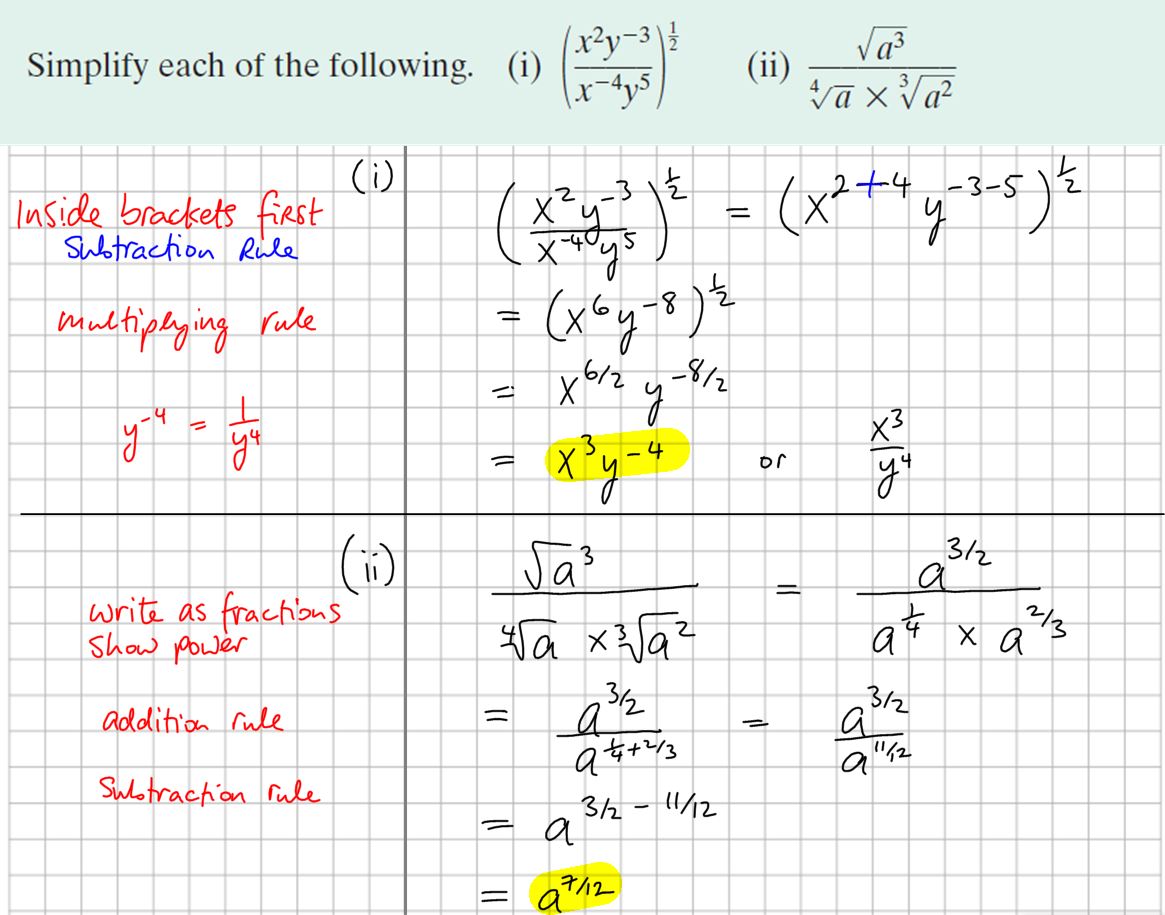
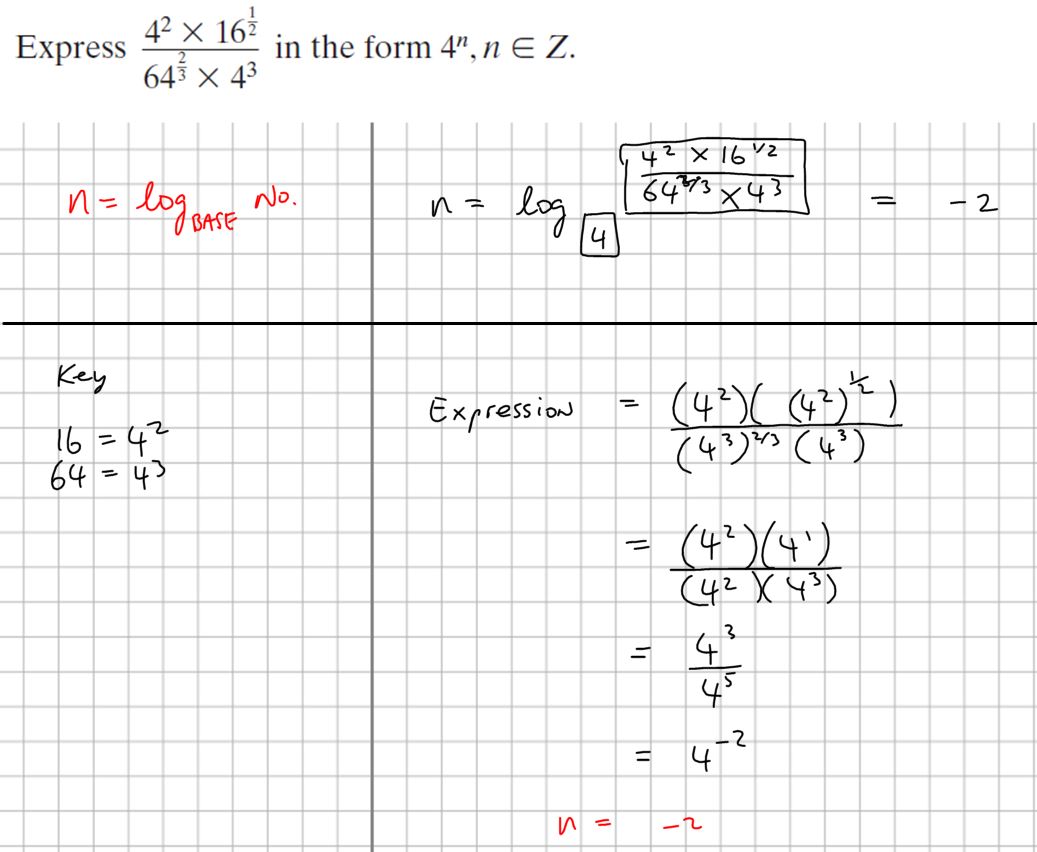
Q1: Simplify \(3x^{2}y^{3}\times2x^{4}y\). ▼

Solution.

Multiply coefficients and add indices of like bases:

\[ 3x^{2}y^{3}\times2x^{4}y = (3\times2)x^{2+4}y^{3+1}=6x^{6}y^{4}. \]

\(\boxed{6x^{6}y^{4}}\)

Q2: Simplify \(\dfrac{a^{-3}b^{4}}{a^{2}b^{-1}}\). ▼

Solution.

Subtract exponents of same bases:

\[ a^{-3-2}b^{4-(-1)}=a^{-5}b^{5} =\frac{b^{5}}{a^{5}}. \]

\(\boxed{\dfrac{b^{5}}{a^{5}}}\)

Q3: Simplify \(\left(16x^{8}\right)^{\tfrac{1}{4}}\). ▼

Solution.

Apply \((a^{m})^{n}=a^{mn}\):

\[ (16x^{8})^{\tfrac{1}{4}} =16^{\tfrac{1}{4}}x^{8\tfrac{1}{4}} =2x^{2}. \]

\(\boxed{2x^{2}}\)

Video Tutorial
Section 12.7 — Exponential Equations: Summary ▼
  • Use laws of indices to rewrite with a common base where possible. If \(a>0\) and \(a\ne1\), then \(a^{x}=a^{y}\iff x=y\).
  • When bases differ, take logarithms (any base): from \(a^{f(x)}=b\) we get \(f(x)=\dfrac{\ln b}{\ln a}\) or generally \(f(x)\ln a=\ln b\).
  • Factor when an equation contains repeated terms (e.g. \(2^{x}\) appearing in several places).
  • Always consider domains (exponentials are positive) and check for extraneous results introduced by algebraic manipulation.

Exponential Equations — Interactive Questions

Q1: Solve \(3^{x+1}=27\). ▼

Solution.

Since \(27=3^{3}\), we have \(3^{x+1}=3^{3}\Rightarrow x+1=3\Rightarrow \boxed{x=2}.\)

Q2: Solve \(7^{x}=3^{x+1}\) for \(x\in\mathbb{R}\). ▼

Solution.

Take natural logs (any log base works):

\[ x\ln 7=(x+1)\ln 3\ \Rightarrow\ x\ln 7=x\ln 3+\ln 3 \ \Rightarrow\ x(\ln 7-\ln 3)=\ln 3. \]

\[ \boxed{\,x=\dfrac{\ln 3}{\ln 7-\ln 3}\,}. \]

Q3: Solve \(2^{x}+2^{x+1}=12\). ▼

Solution.

Factor \(2^{x}\): \(2^{x}(1+2)=12\Rightarrow 3\cdot2^{x}=12\Rightarrow 2^{x}=4.\)

Hence \(x=\boxed{2}\).

Video Tutorial
Section 12.8 — Exponential Functions: Summary ▼
  • Exponential functions have the form \(f(x)=a^{x}\) (or more generally \(f(x)=A\,a^{x}\)) with \(a>0,\ a\neq1\).
  • Key points: \(f(0)=1\Rightarrow(0,1)\), \(f(1)=a\Rightarrow(1,a)\), \(f(-1)=\tfrac{1}{a}\Rightarrow(-1,\tfrac{1}{a})\).
  • Domain: \(\mathbb{R}\); Range: \(f(x)>0\); horizontal asymptote \(y=0\).
  • Behaviour: growth if \(a>1\); decay if \(0<a<1\).
  • Applications include growth/decay and other real-world models.

Exponential Functions — Interactive Questions

Q1: Consider \(f(x)=a^{x}\) with \(a>0,\ a\neq 1\). (i) State three points common to all such graphs. (ii) State the horizontal asymptote and range. (iii) Decide when the function shows growth and when it shows decay. ▼

Solution.

(i) \((0,1),\ (1,a),\ \big(-1,\tfrac{1}{a}\big)\).

(ii) Horizontal asymptote: \(y=0\); range: \(f(x)>0\).

(iii) Growth if \(a>1\); decay if \(0<a<1\).

Q2: The number of days, \(D\), that yoghurt stays fresh at temperature \(T^\circ\mathrm{C}\) is modelled by \(D=18(0.72)^{T}\). (i) Is this growth or decay? (ii) Find \(D\) when \(T=5,2,0\). (iii) Estimate the temperature needed for at least 5 days’ freshness. ▼

Solution.

(i) Since \(0.72<1\), this is decay as \(T\) increases.

(ii) \[ D(5)=18(0.72)^{5},\qquad D(2)=18(0.72)^{2},\qquad D(0)=18. \]

(iii) Solve \(18(0.72)^{T}\ge 5\Rightarrow (0.72)^{T}\ge \tfrac{5}{18}\). Taking logs: \(T\le\dfrac{\ln(5/18)}{\ln(0.72)}\) (note \(\ln(0.72)<0\), so the inequality reverses when dividing). Give \(T\) to the nearest whole degree as required.

Q3: Carbon-14 decays according to \(P=100(0.99988)^{n}\), where \(P\) is the percentage of original carbon remaining after \(n\) years. (i) Find \(P\) after \(200\) and \(500\) years. (ii) Estimate the time to decay to \(50\%\). (iii) If a bone has \(79\%\) remaining, estimate its age. ▼

Solution.

(i) \(\displaystyle P(200)=100(0.99988)^{200},\qquad P(500)=100(0.99988)^{500}.\)

(ii) Set \(100(0.99988)^{n}=50\Rightarrow (0.99988)^{n}=0.5\Rightarrow n=\dfrac{\ln 0.5}{\ln 0.99988}\) years (round appropriately).

(iii) Set \(100(0.99988)^{n}=79\Rightarrow n=\dfrac{\ln(0.79)}{\ln(0.99988)}\) years.

Video Tutorial
Section 12.9 — Laws of Logarithms & Logarithmic Functions: Summary ▼
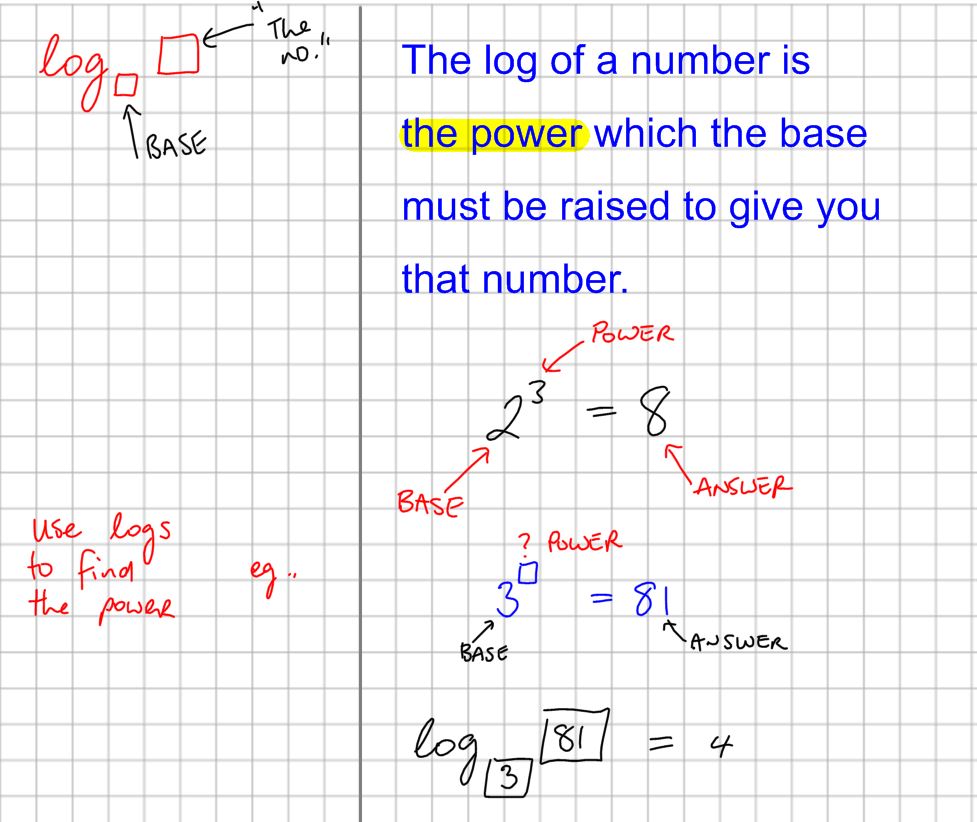
  • Definition: for \(a>0,\ a\neq1,\ x>0\), \(y=\log_{a}x\iff a^{y}=x\).
  • Laws of logs (same base \(a\)):
    • \(\log_{a}(XY)=\log_{a}X+\log_{a}Y\)
    • \(\log_{a}\!\left(\dfrac{X}{Y}\right)=\log_{a}X-\log_{a}Y\)
    • \(\log_{a}(X^{k})=k\,\log_{a}X\)
    • Change of base: \(\displaystyle \log_{a}x=\frac{\log_{b}x}{\log_{b}a}\).
  • \(\ln x=\log_{e}x\). Logs are defined only for \(x>0\).
  • Graph \(y=\log_{a}x\) (\(a>1\)): domain \(x>0\); range \(\mathbb{R}\); vertical asymptote \(x=0\); increasing if \(a>1\).
  • Exponential and logarithmic functions are inverses: \(a^{\log_{a}x}=x\) and \(\log_{a}(a^{x})=x\).

Logarithms & Log Functions — Interactive Questions

Q1: Simplify each expression without a calculator:
(a) \(\log_{2}32-\log_{2}4+\log_{2}\!\left(\tfrac{1}{8}\right)\)  (b) \(\log_{3}27^{\,2/3}\)  (c) \(\dfrac{\log 50}{\log 2}-\dfrac{\log 25}{\log 2}\)
▼

Solution.

(a) \(\log_{2}32=5,\ \log_{2}4=2,\ \log_{2}\!\big(\tfrac{1}{8}\big)=-3\Rightarrow5-2-3=0.\ \boxed{0}\)

(b) \(\log_{3}27^{\,2/3}=\tfrac{2}{3}\log_{3}27=\tfrac{2}{3}\times3=\boxed{2}\)

(c) \(\dfrac{\log50}{\log2}-\dfrac{\log25}{\log2} =\dfrac{\log(50/25)}{\log2}=\log_{2}2=\boxed{1}\)

Q2: Solve each equation for \(x\), using logs where necessary:
(i) \(5^{x}=140\)  (ii) \(3^{2x-1}=10\)
▼

Solution.

(i) Take logs (base 10 or \(e\)): \(x\log5=\log140\Rightarrow \boxed{x=\frac{\log140}{\log5}\approx3.12}\)

(ii) \((2x-1)\log3=\log10\Rightarrow2x-1=\frac{\log10}{\log3}\Rightarrow \boxed{x=\tfrac12\!\left(1+\frac{\log10}{\log3}\right)\approx1.55}\)

Q3: The pH of a solution is defined by \(pH=-\log_{10}[H^{+}]\), where \([H^{+}]\) is the hydrogen ion concentration in mol L\(^{-1}\).
(i) Find the pH when \([H^{+}]=4.0\times10^{-5}\).
(ii) If the pH is 3.4, find \([H^{+}]\).
(iii) Explain how an increase of 1 pH unit affects \([H^{+}]\).
▼

Solution.

(i) \(pH=-\log_{10}(4.0\times10^{-5}) =-(\log4.0+\log10^{-5})=-(0.6021-5)=4.398\Rightarrow\boxed{pH\approx4.40}\)

(ii) \([H^{+}]=10^{-pH}=10^{-3.4}=\boxed{4.0\times10^{-4}}\text{ mol L}^{-1}\)

(iii) Each increase of 1 in pH corresponds to \([H^{+}]\) dividing by 10 (ten-fold decrease in concentration).

Q4: Solve the equation \(\log_{5}(2x+3)=2-\log_{5}(x+1)\) and state the domain. ▼

Solution.

Domain: \(x>-1\) and \(2x+3>0\Rightarrow x>-1.5\); hence \(x>-1\).

\(\log_{5}\!\frac{2x+3}{x+1}=2\Rightarrow\frac{2x+3}{x+1}=25 \Rightarrow2x+3=25x+25\Rightarrow23x=-22\Rightarrow \boxed{x=-\tfrac{22}{23}}\).

Check domain: \(-\tfrac{22}{23}\approx-0.956>-1\) ✅ valid solution.

Section 12.10 — Comparing Logarithmic and Exponential Functions: Summary ▼
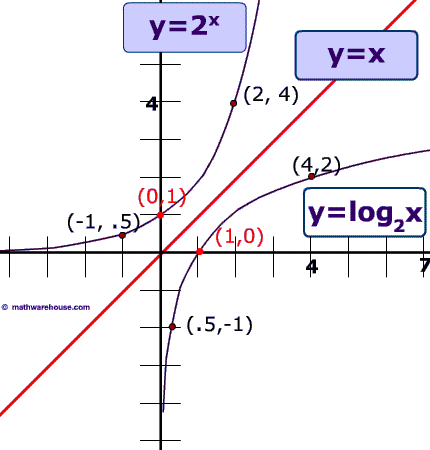
  • Exponential and logarithmic functions are inverses: \[ y=a^{x}\;\Longleftrightarrow\;x=\log_{a}y. \]
  • The graph of \(y=\log_{a}x\) is the reflection of \(y=a^{x}\) in the line \(y=x\).
  • Exponential \(y=a^{x}\): domain \(\mathbb{R}\); range \((0,\infty)\); horizontal asymptote \(y=0\).
  • Logarithmic \(y=\log_{a}x\): domain \((0,\infty)\); range \(\mathbb{R}\); vertical asymptote \(x=0\).
  • Typical inverse pairs: \(y=10^{x}\) ↔ \(y=\log_{10}x\); \(y=2^{x}\) ↔ \(y=\log_{2}x\); \(y=e^{x}\) ↔ \(y=\ln x\).
  • At \(x=1,\ y=0\) for all logs; at \(x=0,\ y=1\) for all exponentials.

Comparing Logarithmic & Exponential Functions — Interactive Questions

Q1: Explain how the graphs of \(y=10^{x}\) and \(y=\log_{10}x\) are related. Describe their intersection and asymptotes. ▼

Solution.

  • The graphs are inverses: each point \((x,y)\) on \(y=10^{x}\) corresponds to \((y,x)\) on \(y=\log_{10}x\).
  • They are reflections in the line \(y=x\).
  • They intersect where \(x=y\Rightarrow y=10^{y}\), giving approximately \((1.26,1.26)\).
  • \(y=10^{x}\) has horizontal asymptote \(y=0\); \(y=\log_{10}x\) has vertical asymptote \(x=0\).
Q2: Complete and compare the tables of values for \(y=10^{x}\) and \(y=\log_{10}x\) for \(x=-2,-1,0,1,2\). What pattern do you notice? ▼

Solution.

x\(y=10^{x}\)\(y=\log_{10}x\)
-20.01– undefined
-10.1– undefined
010
1101
21002

The ordered pairs of one graph become reversed on the other: e.g. \(10^{1}=10\) ↔ \(\log_{10}10=1\). Thus, the two graphs are mirror images in \(y=x\).

Picture
Section 12.11 — Problem-solving with Exponential and Log Functions: Summary ▼
  • Recognise exponential growth or decay models: \(A(t)=A_{0}(1+r)^{t}\) or \(A(t)=A_{0}a^{t}\) where \(a>0,\ a\neq1\).
  • Use logarithms to solve for unknown time or exponent: from \(a^{x}=k\) we get \(x=\dfrac{\ln k}{\ln a}\).
  • Always check that exponential quantities are positive and that logarithm arguments are valid.
  • Include correct units and interpret results in context.
  • For crossover problems, equate models and solve for the time when they are equal.

Problem-solving — Interactive Questions

Q1: A savings account holds €5,000 and earns \(3.2\%\) compound interest per year. (i) Find the balance after \(6\) years. (ii) Find the time (to the nearest year) for the balance to double. ▼

Solution.

(i) The growth model is \[ A(t)=5000(1.032)^{t}. \] For \(t=6\): \[ A(6)=5000(1.032)^{6}\approx6040.3. \] Hence the balance after six years is €6,040 (approx.).

(ii) To find when the amount doubles: \[ 5000(1.032)^{t}=10000 \;\Longrightarrow\; (1.032)^{t}=2. \] Taking logs: \[ t=\frac{\ln2}{\ln(1.032)}\approx21.96. \] Therefore, the money doubles in about 22 years.

Q2: A substance decays according to \(m(t)=m_{0}(0.87)^{t}\), where \(t\) is measured in days. How long until only \(20\%\) of the initial mass remains? ▼

Solution.

Set \(\dfrac{m(t)}{m_{0}}=0.20\): \[ (0.87)^{t}=0.20 \;\Longrightarrow\; t=\frac{\ln(0.20)}{\ln(0.87)}. \] \[ t\approx11.5. \] Therefore, it takes about 12 days for the mass to fall to \(20\%\) of its original value.

Q3: Quantity \(A\) grows as \(A(t)=200(1.08)^{t}\), while quantity \(B\) decays as \(B(t)=500(0.92)^{t}\), where \(t\) is measured in years. After how many years are they equal? ▼

Solution.

Set \(200(1.08)^{t}=500(0.92)^{t}\). Divide both sides by \(200\): \[ \left(\frac{1.08}{0.92}\right)^{t}=\frac{500}{200}=2.5. \] Taking logs: \[ t=\frac{\ln(2.5)}{\ln(1.08/0.92)}\approx5.7. \] Hence, after about 6 years, the growing quantity \(A\) overtakes \(B\).

Section 12.12 — Proofs by Induction: Summary ▼
  • Induction structure: (i) Base case; (ii) Inductive hypothesis (assume true for \(n=k\)); (iii) Inductive step (prove for \(n=k+1\)); (iv) Conclude for all stated \(n\).
  • Included exemplars: one identity, one inequality, one factorisation (divisibility) result.
  • Clearly state domains (e.g. \(n\in\mathbb{N}\), or \(n\ge 4\)), and show every logical step.

Induction — Interactive Questions (3 Exemplars)

Q1 (Identity): Prove by induction that \(\displaystyle 1+2+\cdots+n=\frac{n(n+1)}{2}\) for \(n\in\mathbb{N}\). ▼

Proof (Induction).

Base case: \(n=1\): LHS \(=1\), RHS \(=\frac{1\cdot2}{2}=1\) ✓.

Inductive step: Assume for \(n=k\) that \(1+\cdots+k=\frac{k(k+1)}{2}\). Then \[ 1+\cdots+k+(k+1)=\frac{k(k+1)}{2}+(k+1) =(k+1)\!\left(\frac{k}{2}+1\right) =\frac{(k+1)(k+2)}{2}. \] Hence the result holds for \(n=k+1\). By induction, it holds for all \(n\in\mathbb{N}\).

Q2 (Inequality): Prove by induction that \(2^{\,n}\ge n^{2}\) for all \(n\ge 4\). ▼

Proof (Induction).

Base case: \(n=4\): \(2^{4}=16=4^{2}\) ✓.

Inductive step: Assume \(2^{k}\ge k^{2}\) for some \(k\ge4\). Then \[ 2^{k+1}=2\cdot2^{k}\ \ge\ 2k^{2}. \] It suffices to show \(2k^{2}\ge (k+1)^{2}\), i.e. \[ 2k^{2}-(k+1)^{2}=k^{2}-2k-1\ \ge\ 0\quad(\text{true for }k\ge4). \] Hence \(2^{k+1}\ge (k+1)^{2}\). By induction, \(2^{n}\ge n^{2}\) for all \(n\ge4\).

Q3 (Factorisation): Prove by induction that \(3\) divides \(4^{n}-1\) for all \(n\in\mathbb{N}\); i.e. \(3\mid(4^{n}-1)\). ▼

Proof (Induction).

Base case: \(n=1\): \(4^{1}-1=3\) is divisible by \(3\) ✓.

Inductive step: Assume \(4^{k}-1=3m\) for some \(m\in\mathbb{Z}\). Then \[ 4^{k+1}-1=4\cdot4^{k}-1 =4(4^{k}-1)+3 =4\cdot(3m)+3 =3(4m+1), \] which is divisible by \(3\). Therefore \(3\mid(4^{k+1}-1)\). By induction, \(3\) divides \(4^{n}-1\) for all \(n\in\mathbb{N}\).

Powered by Create your own unique website with customizable templates.