eMaths.ie
  • Home
    • Contact
    • Revision Notes
    • 150 HL Revision Questions
    • Exam Layout
    • T&T Solutions
    • Calculators
    • Geogebra
    • Formulae and Tables Book
    • Applied Maths
    • Projectmaths.ie
  • HL Paper 1
    • Algebra 1
    • Algebra 2
    • Algebra 3
    • Financial Maths
    • Algebra Overview
    • Proof by Induction
    • Functions
    • Graphing Polynomials
    • Differentiation
    • Integration
    • Sequences & Series
    • Arithmetic and Money
    • Number Systems
    • Complex Numbers
    • Paper 1 - Must Learn
  • HL Paper 2
    • The Line
    • Probability
    • Statistics
    • Geometry
    • Area and Volume
    • The Circle
    • Trigonometry Overview
    • Trigonometry 1
    • Trigonometry 2
    • Paper 2 - Must Learn
  • HL Exam Papers
    • Printable Exam Questions
    • Exam Question Solutions & Marks
    • Molloy Maths LCHL Exam Videos
    • Revision Questions
  • OL Topics
    • OL Algebra
    • OL Complex Numbers
    • OL Calculus
    • OL Normal Curve and Hypothesis Testing
    • OL Statistics
    • OL Probability
    • OL Area & Volume
    • OL Trigonometry
    • OL Circle
Section 1 — Compound Interest Section 2 — Investments & Savings Section 3 — Present & Future Value Section 4 — Loans & Mortgages Section 5 — Arithmetic & Money

Financial Maths

Picture

Financial Maths — Sections 1–4: Key Learning Outcomes Checklist

✅ Confident — I can do this independently Need Practice — I get it but need more practice ⛔ Not Yet — I do not understand this yet
Open Self-Check & Study Plan ▼
Outcomes: 0
Confident: 0
Need Practice: 0
Not Yet: 0
Progress autosaves on this device.

□ High Priority — “Not Yet”

    □ Medium Priority — “Need Practice”

      □ Maintain — “Confident”

        Top ↑
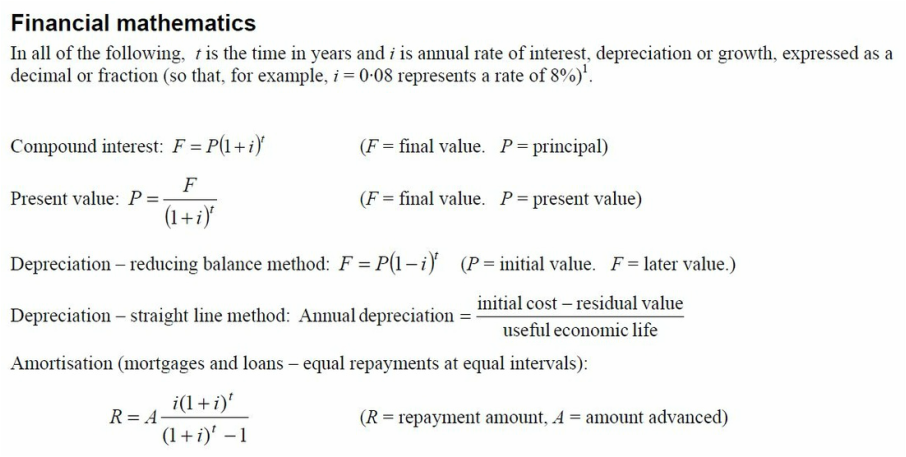
        • Compound interest arises when interest earned each period is added to the principal so that subsequent interest is calculated on the increased total.

        Compound Interest — Formula Book p.30

        \( F = P(1 + i)^t \)
        where: F is the final (future) value
        P is the principal (initial value)
        i is the interest rate per period
        t is the number of periods
        Used when an amount grows by the same percentage rate each period.

        Compound Interest — Future Value & Interest Earned

        Find the future value of €5000 invested at 4% (AER) per annum, compounded annually, for 6 years. Find also the interest earned over the period.
        Worked solution
        Use the compound interest formula: \( A = P(1 + r)^{n} \).
        Substitute: \( P = 5000 \), \( r = 0.04 \), \( n = 6 \).
        \( A = 5000(1.04)^{6} = 5000 \times 1.265319 = 6326.60 \).
        Future value: €\(6326.60\).
        Interest earned \( = A - P = 6326.60 - 5000 = 1326.60 \).
        Interest: €\(1326.60\).

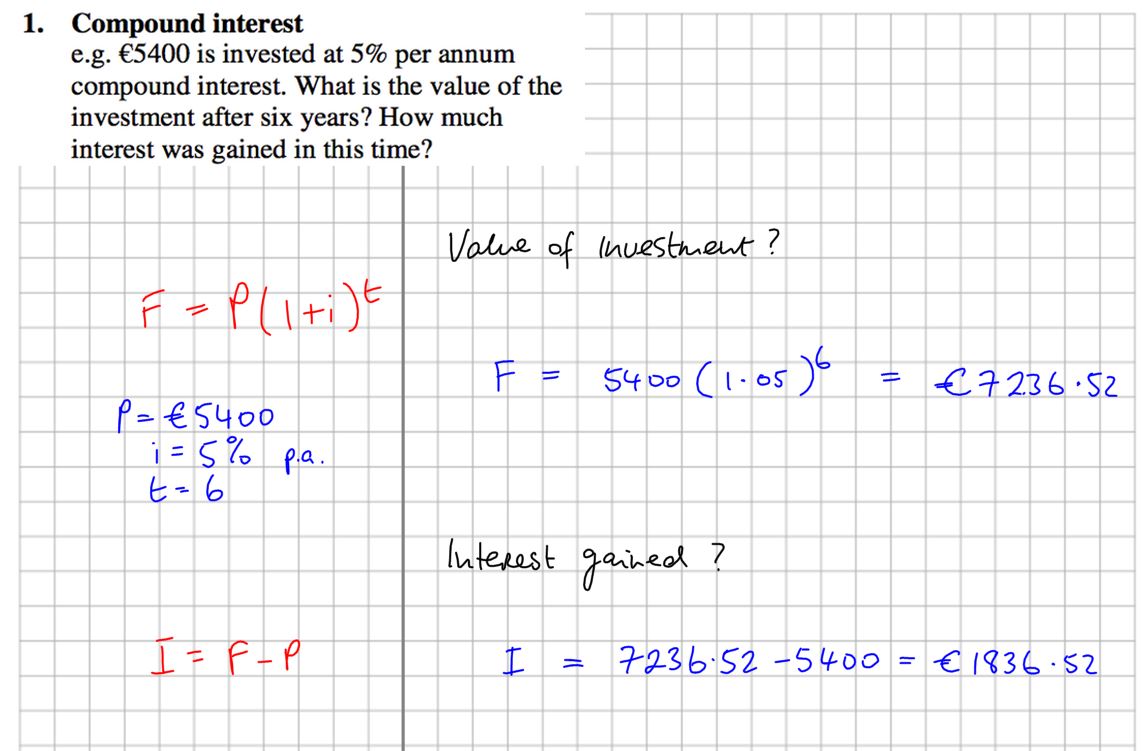
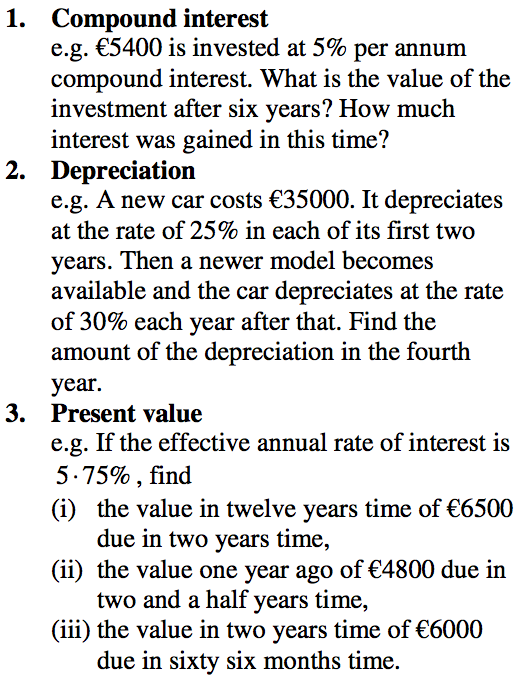
        Compound Interest

        €5400 is invested at 5% per annum compound interest.
        What is the value of the investment after six years?
        How much interest was gained in this time?
        Worked solution
        Formula: \( A = P(1 + r)^t \)
        Given:
        \( P = 5400 \), \( r = 0.05 \), \( t = 6 \)
        Substitute into the formula:
        \[ A = 5400(1.05)^6 \]
        \( (1.05)^6 = 1.3401 \)
        \( A = 5400 \times 1.3401 = 7236.54 \)
        Future value: €\(7\,236.54\)
        Interest earned: \( 7\,236.54 - 5\,400 = 1\,836.54 \)
        Answer: The investment is worth €7 236.54, and the interest gained is €1 836.54.

        AER from Total Return

        An investment bond offers a return of 15% if invested for 4 years. Calculate the AER (annual equivalent rate) for this bond, correct to two decimal places.
        Worked solution
        Let the total growth factor over 4 years be \(1.15\).
        We need the equivalent annual growth factor \(g\) satisfying \(g^{4} = 1.15\).
        Thus \( g = (1.15)^{1/4} = 1.0355 \).
        Hence the AER \( = g - 1 = 0.0355 = 3.55\%.\)
        Answer: AER = 3.55% (to two decimal places).

        AER with Monthly Additions

        €5000 is invested at 4% AER. If the interest is added monthly, find the future value of this investment after (i) \(3\frac{1}{2}\) years (ii) 5 years 2 months.
        Worked solution
        AER of 4% means the annual growth factor is \(1.04\).
        If interest is added monthly, we still use \( A = P(1.04)^{t} \), where \(t\) is the time in years (including fractions).
        (i) \(3\frac{1}{2}\) years
        \( t = 3.5 \) years.
        \( A = 5000(1.04)^{3.5} \approx 5000 \times 1.14714 = 5735.70 \).
        Future value after \(3\frac{1}{2}\) years: €\(5735.70\) (to two decimal places).
        (ii) 5 years 2 months
        5 years 2 months = \(5 + \dfrac{2}{12} = \dfrac{62}{12}\) years.
        \( A = 5000(1.04)^{62/12} \approx 5000 \times 1.22463 = 6123.16 \).
        Future value after 5 years 2 months: €\(6123.16\) (to two decimal places).

        Present Value — Formula Book p.30

        \( P = \dfrac{F}{(1 + i)^t} \)
        where: P is the present value
        F is the future value
        i is the interest rate (discount rate)
        t is the number of periods
        Used to discount a future amount back to its value today.

        Present Value & Discount Rate

        The local GAA club runs a draw. You win first prize and you are offered: (a) €15 000 now  or  (b) €18 000 in four years’ time. Which prize should you choose to have the greater value? Assume a discount rate of 4%.
        When calculating present value, the rate \( i\% \) is often referred to as the discount rate.
        Worked solution
        We compare the present value of each option using \( PV = \dfrac{FV}{(1 + i)^{n}} \).
        Option (a): €15 000 now ⇒ \( PV = 15\,000 \).
        Option (b): €18 000 in 4 years ⇒ \( PV = \dfrac{18\,000}{(1.04)^{4}} \).
        \( PV = 18\,000 / 1.16986 = 15\,387.54 \).
        Comparison: €15 387.54 (future payment) vs €15 000 (immediate).
        Conclusion: Option (b) has the greater present value, so it is the better choice.

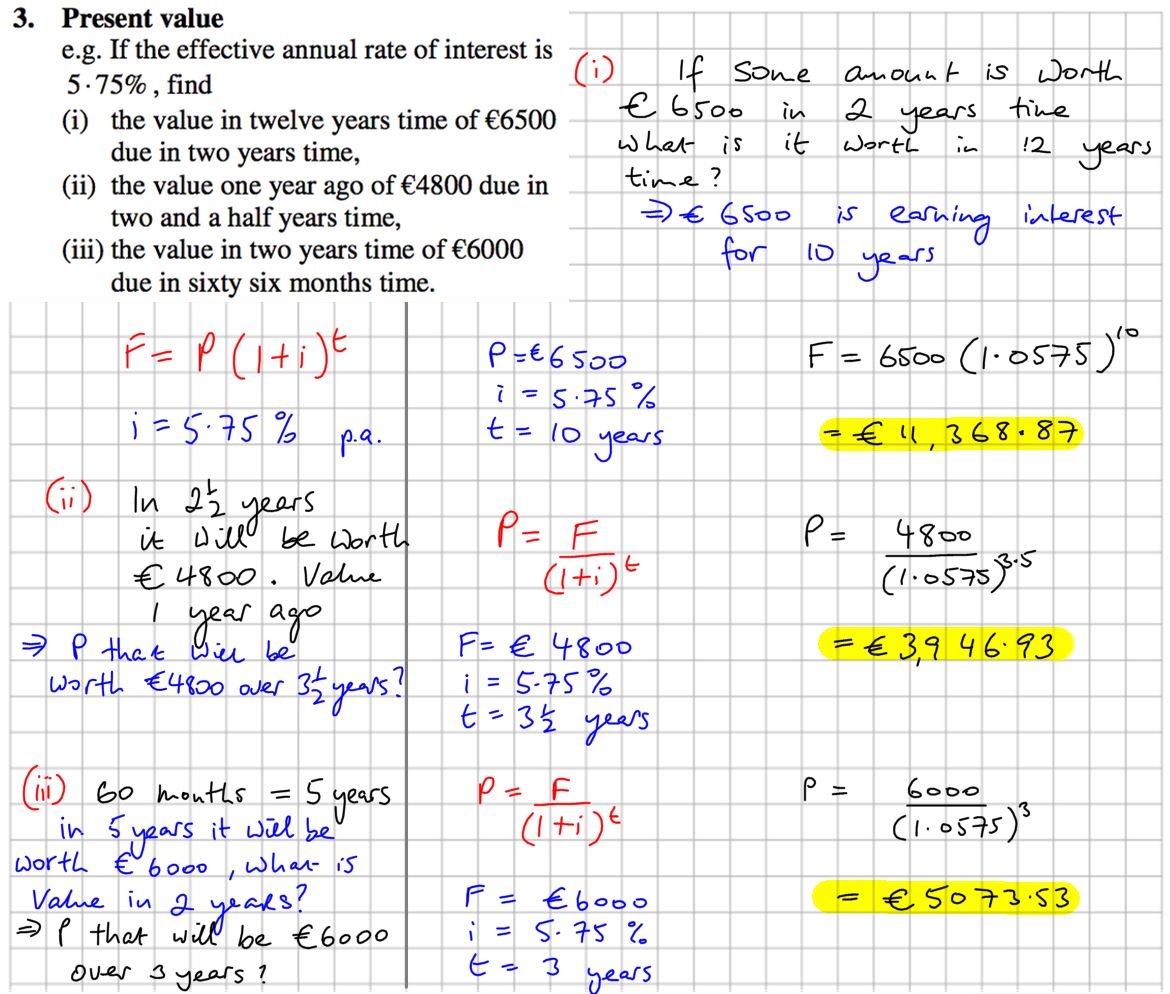
        Present Value

        If the effective annual rate of interest is 5.75%, find:

        (i) the value in twelve years’ time of €6 500 due in two years’ time,
        (ii) the value one year ago of €4 800 due in two and a half years’ time,
        (iii) the value in two years’ time of €6 000 due in sixty-six months’ time.
        Worked solution
        Formula: \( PV = FV(1 + i)^{-t} \)
        Effective annual rate \( i = 5.75\% = 0.0575 \).

        (i) Value in twelve years’ time of €6 500 due in two years’ time.
        We move the payment from 2 years to 12 years — that is, 10 years forward: \[ FV_{12} = 6\,500(1.0575)^{10} \] \( (1.0575)^{10} = 1.747 \)
        \( FV_{12} = 6\,500 \times 1.747 = 11\,355.50 \)
        Answer (i): €11 355.50

        (ii) Value one year ago of €4 800 due in two and a half years’ time.
        The time difference is \( 2.5 + 1 = 3.5 \) years (we go back 3.5 years). \[ PV = 4\,800(1.0575)^{-3.5} \] \( (1.0575)^{-3.5} = 0.823 \)
        \( PV = 4\,800 \times 0.823 = 3\,950.40 \)
        Answer (ii): €3 950.40

        (iii) Value in two years’ time of €6 000 due in sixty-six months’ time.
        \( 66 \text{ months} = 5.5 \text{ years} \).
        Difference = \( 5.5 - 2 = 3.5 \text{ years} \).
        \[ PV_{2} = 6\,000(1.0575)^{-3.5} \] \( (1.0575)^{-3.5} = 0.823 \)
        \( PV_{2} = 6\,000 \times 0.823 = 4\,938.00 \)
        Answer (iii): €4 938.00

        Time to Reach a Target Value

        In how many years would €5000 increase in value to €6500 if invested at an AER of 3.5%?
        Worked solution
        Use \( A = P(1 + r)^{t} \).
        Substitute: \( 6500 = 5000(1.035)^{t} \).
        Divide both sides by 5000: \( 1.3 = (1.035)^{t} \).
        Take logs: \( \log(1.3) = t \log(1.035) \).
        \( t = \dfrac{\log(1.3)}{\log(1.035)} = \dfrac{0.113943}{0.014969} = 7.61 \).
        Answer: \( t \approx 7.6 \) years.

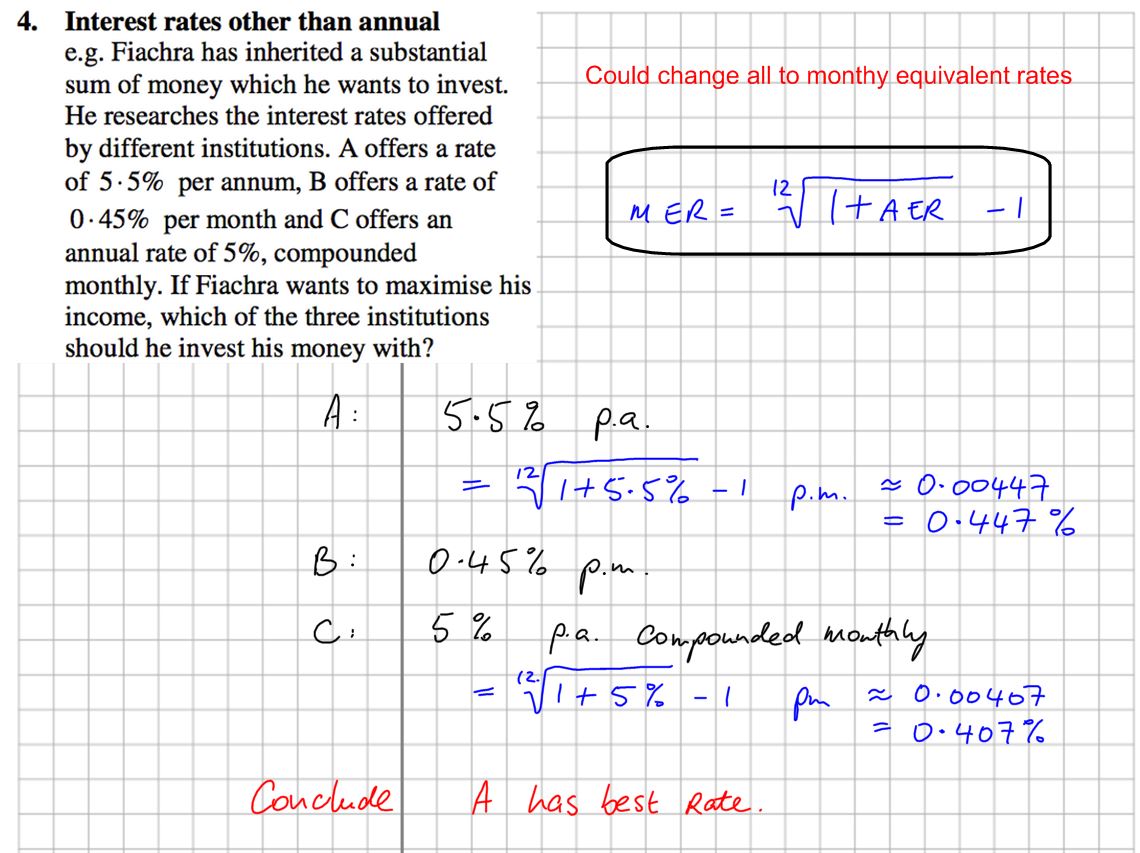
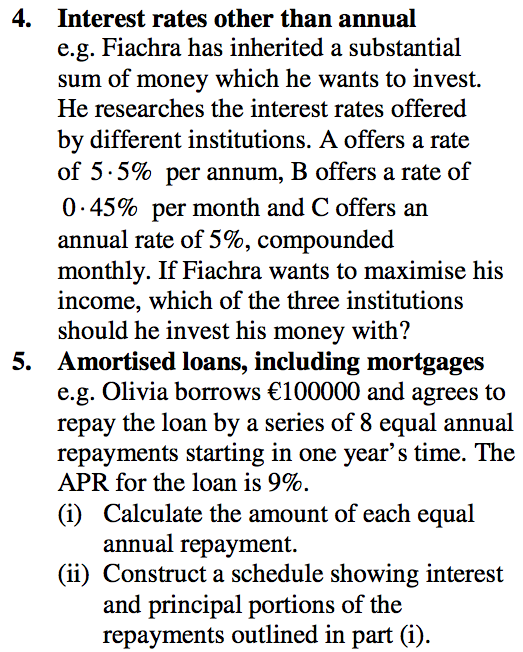
        Interest Rates Other Than Annual

        Fiachra has inherited a substantial sum of money which he wants to invest. He researches the interest rates offered by different institutions. A offers a rate of 5.5% per annum, B offers a rate of 0.45% per month, and C offers an annual rate of 5%, compounded monthly. If Fiachra wants to maximise his income, which of the three institutions should he invest his money with?
        Worked solution
        To compare the offers, convert each to an effective annual rate (AER).
        Institution A
        5.5% per annum is already an annual effective rate. \[ \text{AER}_A = 5.5\%. \]
        Institution B
        Monthly rate \( i_m = 0.45\% = 0.0045 \). Effective annual rate: \[ \text{AER}_B = (1 + i_m)^{12} - 1 = (1.0045)^{12} - 1 \approx 1.05536 - 1 = 0.05536. \]
        \[ \text{AER}_B \approx 5.54\%. \]
        Institution C
        Nominal annual rate 5% compounded monthly. Monthly rate \( i_m = \dfrac{0.05}{12} \approx 0.004167 \). Effective annual rate: \[ \text{AER}_C = (1 + i_m)^{12} - 1 = \left(1 + \frac{0.05}{12}\right)^{12} - 1 \approx 1.05116 - 1 = 0.05116. \]
        \[ \text{AER}_C \approx 5.12\%. \]
        Comparing the AERs: \[ \text{AER}_A = 5.50\%,\quad \text{AER}_B \approx 5.54\%,\quad \text{AER}_C \approx 5.12\%. \]
        Conclusion: Institution B offers the highest effective annual rate, so Fiachra should invest with institution B.

        Annual Equivalent Rate (AER) — Savings Account (LCHL 2024)

        Fiadh deposits money in a savings account. The amount in the account after \(t\) years is given by \[ F(t)=5000e^{0.04t},\quad t\ge0. \]
        Work out the annual rate of interest (AER) for this account. Give your answer as a percentage, correct to 2 decimal places.
        Worked solution
        The balance after \(t\) years is \[ F(t)=5000e^{0.04t}. \]
        At \(t=0\) (now), the amount in the account is \[ F(0)=5000e^{0}=5000. \]
        After one year, \[ F(1)=5000e^{0.04}. \]
        The one–year growth factor is \[ \frac{F(1)}{F(0)} =\frac{5000e^{0.04}}{5000} =e^{0.04}. \]
        The AER is the percentage increase in one year: \[ \text{AER}=e^{0.04}-1. \]
        Calculate \[ e^{0.04}\approx1.0408 \] so \[ e^{0.04}-1\approx0.0408. \]
        Convert to a percentage: \[ 0.0408\times100\%\approx4.08\%. \]
        Answer: The annual rate of interest (AER) is \(\boxed{4.08\%}\) (correct to 2 decimal places).

        …
        Top ↑
        • Depreciation is the decrease in the value of an asset over time, often due to use, age or obsolescence.

        Depreciation (Reducing Balance) — Formula Book p.30

        \( F = P(1 - i)^t \)
        where: F is the later value
        P is the initial value
        i is the annual depreciation rate
        t is the number of years
        Used for assets that lose the same percentage of their value each year.

        Reducing Balance Depreciation

        A company buys a new machine priced at €35 000. The machine depreciates by 20% on a reducing balance basis each year. (i) What will the value of the machine be in 4 years’ time? (ii) By how much has the machine depreciated in value during this time?
        Worked solution
        Reducing balance depreciation with rate \(20\%\) means the value is multiplied by \(1 - 0.20 = 0.8\) each year.
        (i) Value after 4 years
        Use \( V = P(1 - r)^{n} \).
        \( V_{4} = 35\,000(0.8)^{4} \).
        \( (0.8)^{4} = 0.4096 \).
        \( V_{4} = 35\,000 \times 0.4096 = 14\,336 \).
        Value after 4 years: €\(14\,336\).
        (ii) Total depreciation in value
        Original value = €\(35\,000\).
        Depreciation = \(35\,000 - 14\,336 = 20\,664\).
        The machine has depreciated by: €\(20\,664\).

        Petrol Stock — Linear vs Percentage Decrease

        A garage has a petrol stock of 100 000 litres. If the manager estimates (a) that he will sell 4000 litres a day, (b) that he will sell 5% of his stock per day, calculate the difference in his estimates after 20 days.
        Worked solution
        (a) Linear decrease: 4000 litres sold each day.
        After 20 days, total sold = \( 20 \times 4000 = 80\,000 \) litres.
        Remaining stock = \( 100\,000 - 80\,000 = 20\,000 \) litres.
        (b) 5% of stock per day (reducing balance):
        Daily multiplier = \( 1 - 0.05 = 0.95 \).
        After 20 days, remaining stock = \( 100\,000(0.95)^{20} \).
        \( (0.95)^{20} = 0.3585 \).
        Remaining stock = \( 100\,000 \times 0.3585 = 35\,850 \) litres.
        Difference in estimates:
        \( 35\,850 - 20\,000 = 15\,850 \) litres.
        Answer: The percentage estimate leaves 15 850 L more in stock after 20 days.

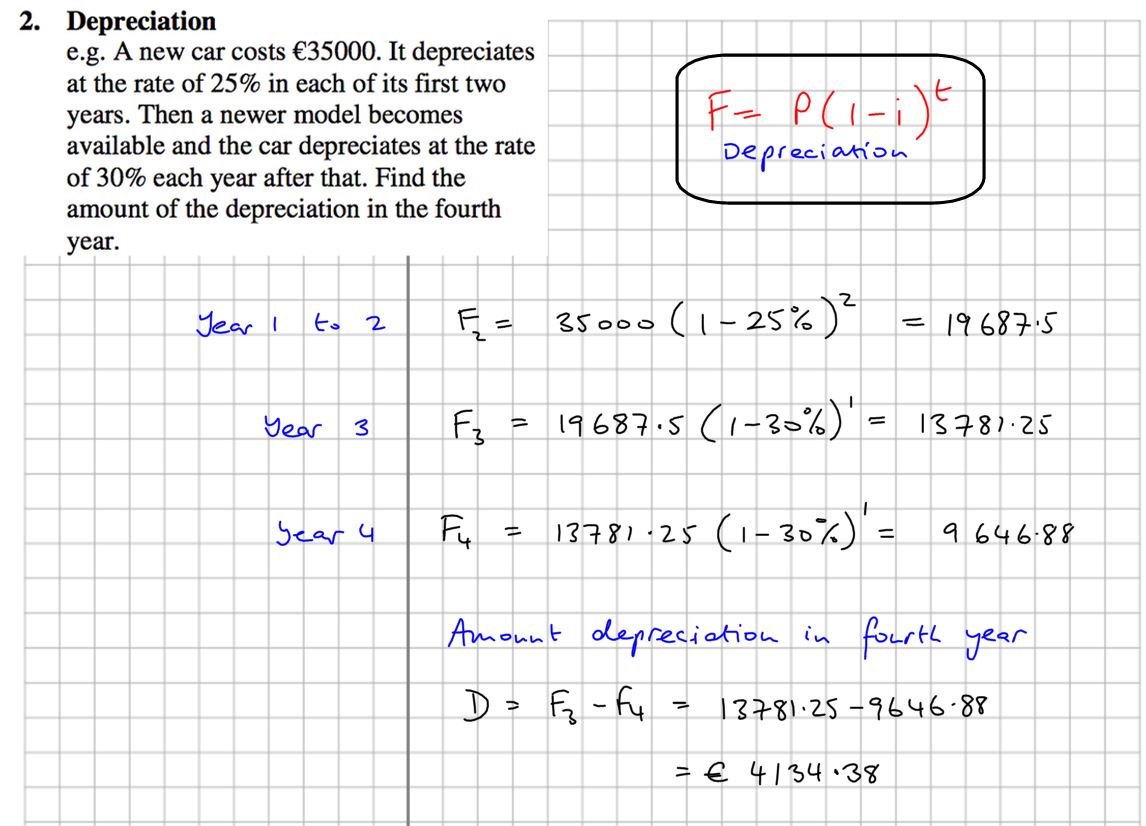
        Depreciation

        A new car costs €35 000. It depreciates at the rate of 25% in each of its first two years. Then a newer model becomes available and the car depreciates at the rate of 30% each year after that. Find the amount of the depreciation in the fourth year.
        Worked solution
        Formula: \( V = P(1 - r)^t \)
        For the first two years, the depreciation rate is 25% (\( r = 0.25 \)).
        Value after 2 years:
        \[ V_2 = 35\,000(0.75)^2 = 35\,000 \times 0.5625 = 19\,687.50 \]
        From year 3 onwards, depreciation is 30% per year (\( r = 0.30 \)).
        Value after year 3:
        \[ V_3 = 19\,687.50(0.70) = 13\,781.25 \]
        Value after year 4:
        \[ V_4 = 13\,781.25(0.70) = 9\,646.88 \]
        Depreciation in the fourth year:
        \[ 13\,781.25 - 9\,646.88 = 4\,134.37 \]
        Answer: The car depreciates by €4 134.37 in the fourth year.

        …
        Top ↑
        • Instalment savings refers to saving a fixed amount at regular intervals, with each payment earning compound interest until the end of the term.

        Sum of a Geometric Series — Formula Book p.22

        \( S_n = \dfrac{a(1 - r^{n})}{1 - r} \)
        where: a is the first term
        r is the common ratio
        n is the number of terms
        Used to find the sum of the first n terms in a geometric sequence.

        Regular Savings — Geometric Series

        Catríona saves €400 every three months for five years at an effective quarterly rate of 0.9%. (i) Represent her savings by a geometric series. (ii) Find the value of her investment at the end of the period.
        Worked solution
        Quarterly rate \( = 0.9\% = 0.009 \), so the growth factor is \( 1.009 \) per quarter.
        Five years with payments every three months gives \( 5 \times 4 = 20 \) payments.
        (i) Geometric series
        Each payment of €400 grows until the end of the 5 years. The value at the end is \[ 400 + 400(1.009) + 400(1.009)^{2} + \cdots + 400(1.009)^{19}, \] a geometric series with first term \(a = 400\), common ratio \(r = 1.009\) and \(n = 20\) terms.
        (ii) Value of the investment
        Sum of a geometric series: \[ S = a\,\frac{r^{n}-1}{r-1}. \]
        \[ S = 400 \times \frac{(1.009)^{20} - 1}{1.009 - 1} \approx 400 \times \frac{1.190598 - 1}{0.009} \approx 400 \times 21.80598 \approx 8722.39. \]
        Value of her investment: €\(8722.39\) (to two decimal places).

        Regular Savings to Reach a Target

        Find the sum of money, €\(P\), that needs to be saved per month to cover the cost of a €1500 holiday in 18 months’ time. The interest rate on offer is 0.4% per month.
        Worked solution
        Monthly rate \( i = 0.4\% = 0.004 \).
        Number of payments \( n = 18 \).
        Future value (target) \( A = 1500 \).
        Formula for the future value of a regular savings plan: \[ A = P \times \frac{(1+i)^{n} - 1}{i}. \]
        Rearrange to find \( P \): \[ P = \frac{A \, i}{(1+i)^{n} - 1}. \]
        Substitute values: \( P = \dfrac{1500(0.004)}{(1.004)^{18} - 1} \).
        \( (1.004)^{18} = 1.0747 \Rightarrow (1.004)^{18} - 1 = 0.0747 \).
        \( P = \dfrac{6.00}{0.0747} = 80.32 \).
        Answer: €\(80.32\) must be saved each month.

        Present Value of an Annuity — Pension Fund

        What amount of money is needed now to provide a pension of €25 000 a year for 20 years, assuming an AER of 4%?
        Worked solution
        Annual payment \( R = 25\,000 \).
        Interest rate \( i = 0.04 \).
        Number of payments \( n = 20 \).
        Present value of an annuity: \[ PV = R \times \frac{1 - (1+i)^{-n}}{i}. \]
        Substitute: \( PV = 25\,000 \times \dfrac{1 - (1.04)^{-20}}{0.04}. \)
        \( (1.04)^{-20} = 0.45639 \Rightarrow 1 - 0.45639 = 0.54361. \)
        \( PV = 25\,000 \times \dfrac{0.54361}{0.04} = 25\,000 \times 13.59025 = 339\,756.25. \)
        Answer: €\(339\,756.25\) needed now (to two decimal places).

        Future & Present Value of Instalment Savings

        Calculate the future value of an instalment savings plan based on saving €600 at the start of each year at 4% per annum for 5 years. (i) Calculate the present value of these payments. (ii) Hence show that if the present value was put on deposit at the same rate for the same length of time, it would have the same future value.
        Worked solution
        Data: yearly payment \(R = 600\), rate \(i = 0.04\), number of years \(n = 5\). Payments are at the start of each year ⇒ an annuity due.
        Future value of an annuity due
        Future value of an ordinary annuity: \[ FV_{\text{ord}} = R\frac{(1+i)^{n}-1}{i}. \] For an annuity due, multiply by one extra factor of \((1+i)\): \[ FV_{\text{due}} = R\frac{(1+i)^{n}-1}{i}(1+i). \]
        \[ FV_{\text{due}} = 600\frac{(1.04)^{5}-1}{0.04}\times 1.04 = 600\frac{1.21665 - 1}{0.04}\times 1.04 = 600\times 5.41625\times 1.04 \approx 3379.79. \]
        Future value: €\(3379.79\) (to two decimal places).
        (i) Present value of these payments
        Present value of an annuity due: \[ PV_{\text{due}} = R\frac{1-(1+i)^{-n}}{i}(1+i). \]
        \[ PV_{\text{due}} = 600\frac{1-(1.04)^{-5}}{0.04}\times 1.04 = 600\frac{1-0.82193}{0.04}\times 1.04 = 600\times 4.45175\times 1.04 \approx 2777.94. \]
        Present value: €\(2777.94\) (to two decimal places).
        (ii) Check using the present value
        Invest the present value for 5 years at 4%: \[ FV = PV_{\text{due}}(1.04)^{5} \approx 2777.94 \times 1.21665 \approx 3379.79. \]
        This matches the future value found earlier, so putting the present value on deposit at the same rate for the same time gives the same future value.

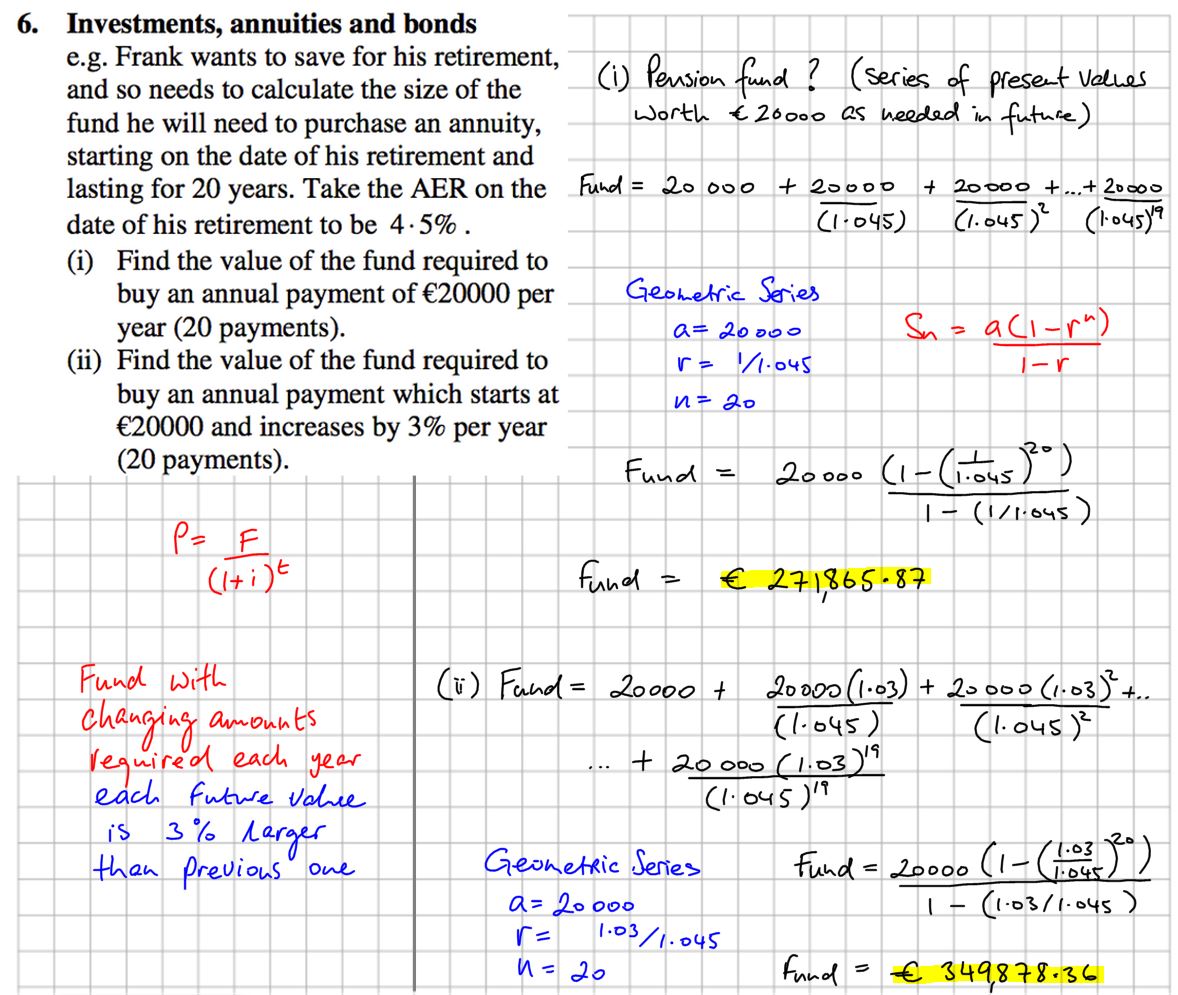
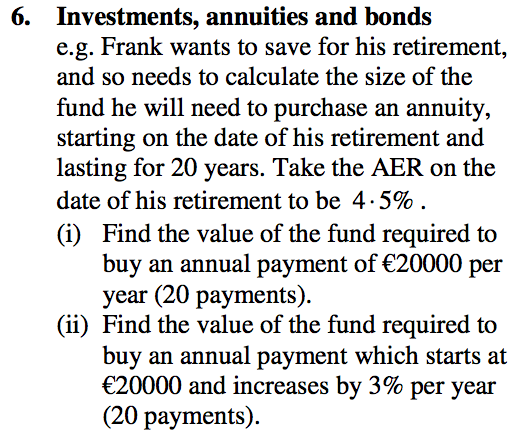
        Investments, Annuities and Bonds

        Frank wants to save for his retirement, and so needs to calculate the size of the fund he will need to purchase an annuity, starting on the date of his retirement and lasting for 20 years. Take the AER on the date of his retirement to be 4.5%.

        (i) Find the value of the fund required to buy an annual payment of €20 000 per year (20 payments).
        (ii) Find the value of the fund required to buy an annual payment which starts at €20 000 and increases by 3% per year (20 payments).
        Worked solution
        Given: \( i = 4.5\% = 0.045 \), \( n = 20 \), \( R = 20\,000 \).
        (i) Level annuity
        Present value of an annuity-immediate: \[ PV = R \times \frac{1 - (1 + i)^{-n}}{i}. \]
        \[ PV = 20\,000 \times \frac{1 - (1.045)^{-20}}{0.045}. \] \( (1.045)^{-20} = 0.4227 \)
        \[ PV = 20\,000 \times \frac{1 - 0.4227}{0.045} = 20\,000 \times 12.8389 = 256\,778. \]
        Answer (i): €256 778 is required to fund 20 payments of €20 000.

        (ii) Increasing annuity (growing at 3%)
        Formula for a growing annuity (growth rate \( g \)): \[ PV = R \times \frac{1 - \left(\frac{1 + g}{1 + i}\right)^{n}}{i - g}. \]
        Substitute: \( R = 20\,000, i = 0.045, g = 0.03, n = 20 \) \[ PV = 20\,000 \times \frac{1 - \left(\frac{1.03}{1.045}\right)^{20}}{0.045 - 0.03}. \]
        Compute: \[ \frac{1.03}{1.045} = 0.9856,\quad (0.9856)^{20} = 0.7496. \] \[ PV = 20\,000 \times \frac{1 - 0.7496}{0.015} = 20\,000 \times 16.6933 = 333\,866. \]
        Answer (ii): €333 866 is required to fund an annuity increasing by 3% per year.

        Conclusion:
        • Level payments (€20 000 per year): Fund required ≈ €256 778.
        • Increasing payments (by 3% annually): Fund required ≈ €333 866.
        Pádraig is 25 years old and is planning for his pension. He intends to retire in forty years’ time, when he is 65. He assumes that, in the long run, money can be invested at an inflation-adjusted annual rate of 3%. All answers should be based on a 3% annual growth rate.
        (a) Write down the present value of a future payment of €20 000 in one year’s time.
        (b) Write down, in terms of \(t\), the present value of a future payment of €20 000 in \(t\) years’ time.
        (c) Pádraig wants to have a fund that, from the date of his retirement, will give him a payment of €20 000 at the start of each year for 25 years. Show how to use the sum of a geometric series to calculate the value, on the date of retirement, of the fund required.

        Pádraig plans to invest a fixed amount of money every month in order to generate this fund. His retirement is \(40 \times 12 = 480\) months away.
        (d)(i) Find, correct to four significant figures, the rate of interest per month that, if paid and compounded monthly, is equivalent to an effective annual rate of 3%.
        (d)(ii) Write down, in terms of \(n\) and \(P\), the value on the retirement date of a payment of €\(P\) made \(n\) months before the retirement date.
        (d)(iii) If Pádraig makes 480 equal monthly payments of €\(P\) from now until his retirement, what value of \(P\) will give the fund he requires?
        (e) If Pádraig waits for ten years before starting his pension investments, how much will he then have to pay each month in order to generate the same pension fund?
        Worked solution
        (a) Present value of €20 000 in one year: \[ PV = \frac{20\,000}{1.03} \approx 19\,417.48. \]
        (b) In general, for a payment in \(t\) years’ time: \[ PV(t) = \frac{20\,000}{(1.03)^{t}}. \]
        (c) Payments of €20 000 are made at the start of each year for 25 years from retirement. Measured at the retirement date, the sequence of present values is \[ 20\,000 + \frac{20\,000}{1.03} + \frac{20\,000}{(1.03)^{2}} + \cdots + \frac{20\,000}{(1.03)^{24}}. \]
        This is a geometric series with first term \(20\,000\), common ratio \(r = \dfrac{1}{1.03}\) and \(25\) terms. Its sum (the required fund \(F\)) is \[ F = 20\,000\, \frac{1 - \left(\dfrac{1}{1.03}\right)^{25}} {1 - \dfrac{1}{1.03}} = 20\,000(1.03)\,\frac{1 - (1.03)^{-25}}{0.03} \approx 358\,711. \] So Pádraig needs a fund of about €\(358\,711\) at retirement.
        (d)(i) Let the equivalent monthly rate be \(i_m\). Then \[ (1 + i_m)^{12} = 1.03 \quad\Rightarrow\quad i_m = 1.03^{1/12} - 1 \approx 0.002466. \] So the effective monthly rate is \(0.2466\%\).
        (d)(ii) A payment of €\(P\) made \(n\) months before retirement grows for \(n\) months, so its value at retirement is \[ P(1 + i_m)^{n}. \]
        (d)(iii) Pádraig makes 480 equal monthly payments of €\(P\). At retirement, their total value is \[ P(1+i_m) + P(1+i_m)^{2} + \cdots + P(1+i_m)^{480}, \] a geometric series with first term \(P(1+i_m)\), ratio \(1+i_m\), and \(480\) terms.
        Sum: \[ S = P(1+i_m)\,\frac{(1+i_m)^{480} - 1}{(1+i_m) - 1} = P(1+i_m)\,\frac{(1+i_m)^{480} - 1}{i_m}. \] Set this equal to the required fund \(F\): \[ P(1+i_m)\,\frac{(1+i_m)^{480} - 1}{i_m} = F. \] Hence \[ P = F\,\frac{i_m}{(1+i_m)\big((1+i_m)^{480} - 1\big)} \approx 390.14. \] So he must invest about €\(390.14\) per month.
        (e) If he waits 10 years before starting, he then has only \(30\) years \(= 360\) months to invest. Let the new monthly payment be €\(P_2\).
        Future value after 360 payments: \[ P_2(1+i_m)\,\frac{(1+i_m)^{360} - 1}{i_m} = F. \] So \[ P_2 = F\,\frac{i_m}{(1+i_m)\big((1+i_m)^{360} - 1\big)} \approx 618.32. \] Therefore he would need to pay about €\(618.32\) per month if he delays for ten years.

        …
        Top ↑
        • Loans and mortgages involve borrowing money which is repaid in regular instalments that include both principal and interest.
        • Mortgages are long-term loans (usually over 20–30 years) secured on property and repaid monthly using this formula.

        Amortisation — Formula Book p.31

        \( A = P\,\dfrac{i(1 + i)^t}{(1 + i)^t - 1} \)
        where: A is the regular repayment amount
        P is the principal (amount borrowed)
        i is the interest rate per period
        t is the number of repayment periods
        Used for loans and mortgages repaid by equal periodic payments.

        Loan Repayments — Using the Amortisation Formula

        Calculate the size of the monthly repayments needed for a car loan of €10 000 if the loan is to be repaid over a 5-year term at an effective monthly rate of 0.72%.
        Worked solution
        Formula Book (p.31): Amortisation Formula
        The present value of a loan is given by \[ PV = R \times \frac{1 - (1+i)^{-n}}{i} \] where \(R\) is the regular repayment, \(i\) the rate per period, and \(n\) the number of repayments.
        Given: \( PV = 10\,000 \), \( i = 0.72\% = 0.0072 \), \( n = 5 \times 12 = 60 \).
        Rearrange to find \( R \): \[ R = PV \times \frac{i}{1 - (1+i)^{-n}}. \]
        Substitute: \[ R = 10\,000 \times \frac{0.0072}{1 - (1.0072)^{-60}}. \]
        \( (1.0072)^{-60} = 0.6477 \Rightarrow 1 - 0.6477 = 0.3523. \)
        \( R = 10\,000 \times \frac{0.0072}{0.3523} = 10\,000 \times 0.02044 = 204.40. \)
        Monthly repayment: €\(204.40\).
        Total repaid: \( 204.40 \times 60 = 12\,264 \). Interest paid: \( 12\,264 - 10\,000 = 2\,264 \).

        Mortgage Repayments — Using the Amortisation Formula

        Find the monthly repayments required for a mortgage of €150 000, based on an annual rate of 4.5% over 20 years.
        Worked solution
        Formula Book (p.31): Amortisation Formula
        \[ PV = R \times \frac{1 - (1+i)^{-n}}{i} \] where \(PV\) is the amount borrowed, \(R\) is the repayment per period, \(i\) is the rate per period, and \(n\) is the number of repayments.
        Given: \( PV = 150\,000 \), \( i = \frac{0.045}{12} = 0.00375 \), \( n = 20 \times 12 = 240. \)
        Rearrange to find \( R \): \[ R = PV \times \frac{i}{1 - (1+i)^{-n}}. \]
        Substitute: \[ R = 150\,000 \times \frac{0.00375}{1 - (1.00375)^{-240}}. \]
        \( (1.00375)^{-240} = 0.4093 \Rightarrow 1 - 0.4093 = 0.5907. \)
        \( R = 150\,000 \times \frac{0.00375}{0.5907} = 150\,000 \times 0.00635 = 952.50. \)
        Monthly repayment: €\(952.50\).
        Total repaid: \( 952.50 \times 240 = 228\,600 \). Interest paid: \( 228\,600 - 150\,000 = 78\,600. \)

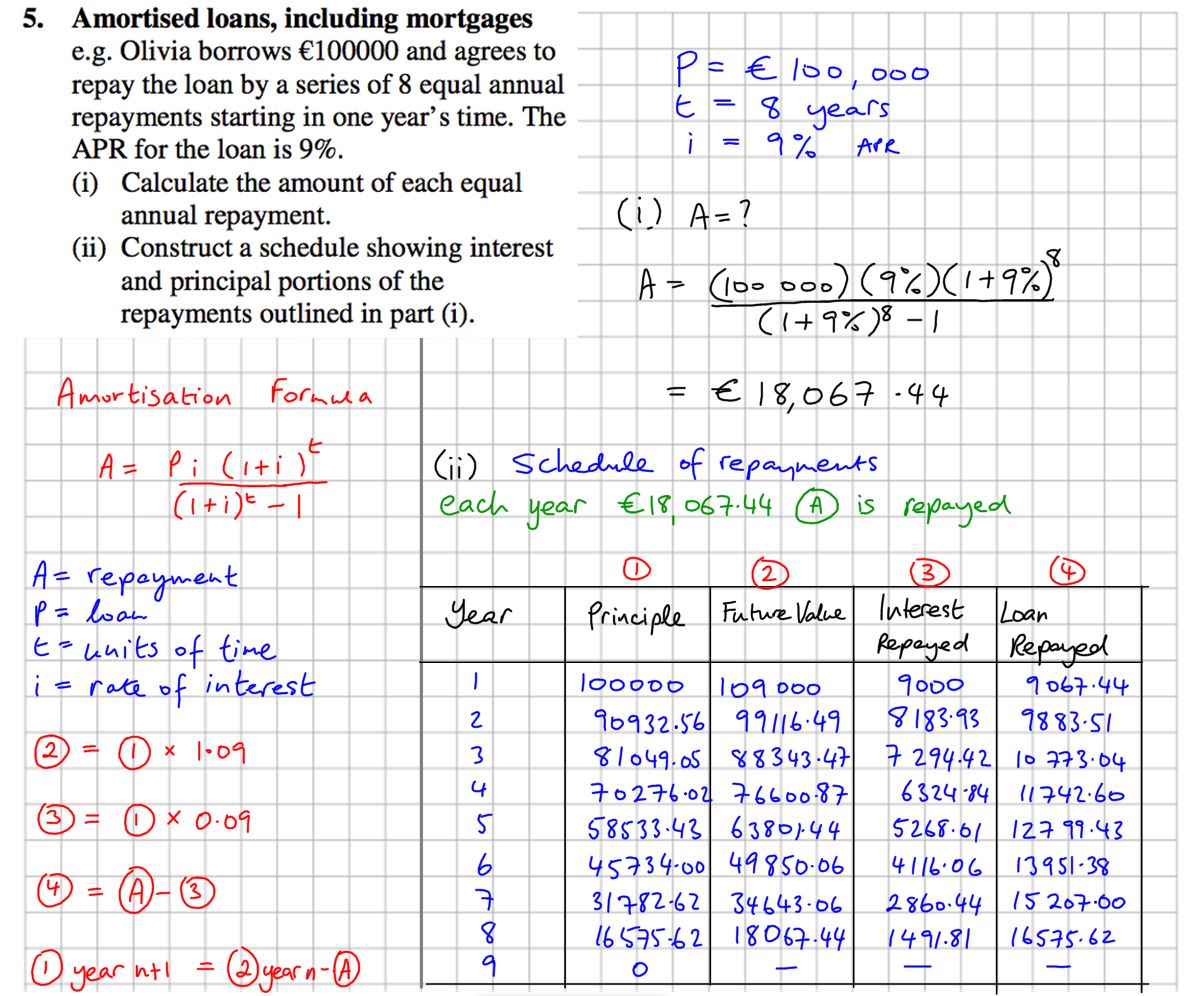
        Amortised Loans, Including Mortgages

        Olivia borrows €100 000 and agrees to repay the loan by a series of 8 equal annual repayments starting in one year’s time. The APR for the loan is 9%.

        (i) Calculate the amount of each equal annual repayment.
        (ii) Construct a schedule showing interest and principal portions of the repayments outlined in part (i).
        Worked solution
        Given: \(PV = 100\,000\), annual rate \(i = 9\% = 0.09\), number of repayments \(n = 8\).
        (i) Size of each annual repayment
        For an amortised loan, the present value is \[ PV = R \,\frac{1-(1+i)^{-n}}{i}, \] where \(R\) is the regular repayment.
        Rearranging, \[ R = PV \,\frac{i}{1-(1+i)^{-n}}. \]
        \[ R = 100\,000 \times \frac{0.09}{1-(1.09)^{-8}} \approx 18\,067.44. \]
        Each annual repayment is approximately €18 067.44.
        (ii) Amortisation schedule
        Each year:
        • \(\text{Interest} = \text{Opening balance} \times 0.09\)
        • \(\text{Principal repaid} = R - \text{Interest}\)
        • \(\text{Closing balance} = \text{Opening balance} - \text{Principal repaid}\)
        Year Opening
        balance (€)
        Interest
        (€)
        Repayment
        \(R\) (€)
        Principal
        repaid (€)
        Closing
        balance (€)
        1 100 000.00 9 000.00 18 067.44 9 067.44 90 932.56
        2 90 932.56 8 183.93 18 067.44 9 883.51 81 049.05
        3 81 049.05 7 294.41 18 067.44 10 773.03 70 276.02
        4 70 276.02 6 324.84 18 067.44 11 742.60 58 533.42
        5 58 533.42 5 268.01 18 067.44 12 799.43 45 733.99
        6 45 733.99 4 116.06 18 067.44 13 951.38 31 782.61
        7 31 782.61 2 860.43 18 067.44 15 207.01 16 575.60
        8 16 575.60 1 491.80 18 067.44 16 575.64 ≈ 0.00*
        *The tiny discrepancy in the final balance is due to rounding each amount to the nearest cent. In exact calculations the closing balance is zero.

        Deriving the Amortisation Formula (LCHL 2017)

        When a loan of €\(P\) is repaid in equal repayments of amount €\(A\), at the end of each of \(t\) equal periods of time, where \(i\) is the periodic compound interest rate (expressed as a decimal), the formula below can be used to find the amount of each repayment: \[ A = P \frac{i(1+i)^{t}}{(1+i)^{t}-1}. \]
        Show how this formula is derived. You may use the formula for the sum of a finite geometric series.
        Worked solution (as per 2017 LC HL Marking Scheme)

        The present value of all repayments equals the loan amount \(P\): \[ P = \frac{A}{1+i} + \frac{A}{(1+i)^2} + \frac{A}{(1+i)^3} + \cdots + \frac{A}{(1+i)^t} \] This is a geometric series with: - first term \(a = \dfrac{A}{1+i}\) - common ratio \(r = \dfrac{1}{1+i}\) - number of terms \(t\)

        Using the formula for the sum of a finite geometric series: \[ S_n = a \frac{1 - r^n}{1 - r} \] we get: \[ P = \left(\frac{A}{1+i}\right)\frac{1 - \left(\frac{1}{1+i}\right)^t}{1 - \frac{1}{1+i}} \] Simplifying the denominator: \[ 1 - \frac{1}{1+i} = \frac{i}{1+i} \] Substituting this gives: \[ P = A\frac{1 - \frac{1}{(1+i)^t}}{1+i - 1} \] \[ = A\frac{(1+i)^t - 1}{i(1+i)^t} \] \[ \boxed{A = P\frac{i(1+i)^t}{(1+i)^t - 1}} \]
        Marking Scheme (Scale 5C)
        • Low partial credit: \(P = \frac{A}{1+i}\), or \(A = P(1+i)\), or use of \(S_n\) formula with some substitution.
        • High partial credit: Full substitution for \(P\) or \(A\) into \(S_n\) formula and correct manipulation.
        …
        Top ↑
        • Percentage error — estimating error in measurements as a percentage of the true value.
        • Accumulation of error — how measurement errors combine in sums and differences.
        • Tolerance and tolerance intervals for measurements made with rulers and instruments.
        • Order of magnitude estimates for real-life quantities (e.g. heartbeats in a lifetime).
        • Household finances — bills, tariffs, VAT, and total cost calculations.
        • Income tax — standard and higher rates, tax credits, net and gross income.
        • Currency exchange — may include commission.
        • Mark-up & Margin — expressions of percentage profit.

        Percentage Error

        The distance between Dublin and Lisbon is estimated to be \(1500\text{ km}\). The true distance is \(1638.92\text{ km}\).

        Calculate the percentage error in the estimate.
        Worked solution (typed)
        Percentage error: \[ \text{Percentage error} = \frac{|\text{estimate} - \text{true value}|}{\text{true value}}\times100\%. \]
        \[ \begin{aligned} \text{Error in distance} &= |1500 - 1638.92| = 138.92\text{ km},\\[2mm] \text{Percentage error} &= \frac{138.92}{1638.92}\times100\% \approx 8.48\%. \end{aligned} \]
        The percentage error is approximately \(8.5\%\).
        Handwritten solution Handwritten solution for Question 1

        Accumulation of Error

        If \[ p = (12.7 \pm 0.15)\text{ km},\qquad q = (10.5 \pm 0.1)\text{ km}, \] calculate the percentage error in
        (i) \(p+q\),
        (ii) \(p-q\).
        Worked solution (typed)
        Maximum absolute error in each measurement: \[ \Delta p = 0.15\text{ km},\qquad \Delta q = 0.10\text{ km}. \]
        (i) Error in \(p+q\)
        Nominal value: \[ p+q = 12.7 + 10.5 = 23.2\text{ km}. \] Maximum absolute error adds: \[ \Delta(p+q) = \Delta p + \Delta q = 0.15+0.10 = 0.25\text{ km}. \] Percentage error: \[ \frac{0.25}{23.2}\times100\% \approx 1.08\%. \]
        (ii) Error in \(p-q\)
        Nominal value: \[ p-q = 12.7 - 10.5 = 2.2\text{ km}. \] Maximum absolute error (again): \[ \Delta(p-q) = 0.25\text{ km}. \] Percentage error: \[ \frac{0.25}{2.2}\times100\% \approx 11.36\%. \]
        Percentage error in \(p+q\) is about \(1.1\%\); in \(p-q\) it is about \(11.4\%\).
        Handwritten solution Handwritten solution for Question 2

        Tolerance and Tolerance Interval

        A ruler is scaled with marks showing every two millimetres.

        (i) What is the tolerance of this ruler?
        (ii) This ruler measures a length to be \(8.7\text{ cm}\). What is the tolerance interval for the length?
        Worked solution (typed)
        (i) Tolerance of the ruler
        The smallest division is \(2\text{ mm}\). Tolerance is half the smallest division: \[ \text{Tolerance} = \pm 1\text{ mm} = \pm 0.1\text{ cm}. \]
        (ii) Tolerance interval for \(8.7\text{ cm}\)
        Measured length \(= 8.7\text{ cm}\) with tolerance \(\pm 0.1\text{ cm}\). So the true length lies in \[ 8.7 - 0.1 \le L \le 8.7 + 0.1 \quad\Rightarrow\quad 8.6 \le L \le 8.8. \]
        The tolerance interval is \(8.7\text{ cm} \pm 0.1\text{ cm}\), i.e. \([8.6,8.8]\text{ cm}\).

        Order of Magnitude — Heartbeats in a Lifetime

        Obtain an order of magnitude estimate for the number of heartbeats in a human life.
        (Take an average of 80 beats per minute and an average lifespan of about 80 years.)
        Worked solution (typed)
        Beats per minute: \(80\). Beats per hour: \[ 80 \times 60 = 4800. \]
        Beats per day: \[ 4800 \times 24 = 115\,200. \]
        Beats per year (using \(365\) days): \[ 115\,200 \times 365 \approx 4.2\times10^{7}. \]
        For \(80\) years: \[ 4.2\times10^{7} \times 80 \approx 3.4\times10^{9}\text{ beats}. \]
        The total number of heartbeats is of order \(10^{9}\) (billions of beats).
        Handwritten solution Handwritten solution for Question 4

        Household Finances — Mobile Phone Plan

        Aoife pays a fixed monthly charge of €15 for her mobile phone. This charge includes 100 free text messages and 50 minutes free call time each month. Further call time costs 28 cent per minute and additional text messages cost 11 cent each.

        In one month Aoife sends 140 text messages and her call time is 2 hours.

        (i) Find the total cost of her fixed charge, text messages and call time.
        (ii) VAT is added to this cost at the rate of 21%. Find the amount paid, including VAT.
        Worked solution (typed)
        (i) Total cost before VAT
        Extra texts: \[ 140 - 100 = 40 \] So there are 40 extra texts.
        Cost of extra texts: \[ 40 \times 0.11 = 4.40 \] So the cost of extra texts is €4.40.
        Call time: \(2\) hours \(= 120\) minutes. Free minutes: \(50\). Extra minutes: \[ 120 - 50 = 70 \] So there are 70 extra minutes.
        Cost of extra minutes: \[ 70 \times 0.28 = 19.60 \] So the cost of extra minutes is €19.60.
        Total cost before VAT: \[ 15 + 4.40 + 19.60 = 39.00 \] So the total cost before VAT is €39.00.
        (ii) Including VAT at \(21\%\)
        VAT amount: \[ 0.21 \times 39.00 = 8.19 \] So the VAT is €8.19.
        Total including VAT: \[ 39.00 + 8.19 = 47.19 \] So the total amount Aoife pays is €47.19.
        Handwritten solution Handwritten solution for Question 5

        Income Tax — Finding Gross Income

        Miriam has an income after tax of €5158 for a particular month. Her tax credits are €320 for the month and the standard rate cut-off point is €2950. The standard and higher rates of tax are 20% and 41% respectively.

        Calculate her gross income for the month.
        Worked solution (typed)
        Let \(G\) be Miriam’s gross income and \(T\) the tax before tax credits.
        Standard rate (20%) applies to the first 2950 and the higher rate (41%) to the balance: \[ T = 0.20\times2950 + 0.41(G-2950) = 590 + 0.41G - 0.41\times2950. \] Since \[ 0.41\times2950 = 1209.5, \] we have \[ T = 0.41G - 619.5. \]
        Tax credits reduce tax by 320, so actual tax paid is \[ T_{\text{paid}} = T - 320. \] Net income is then \[ \text{Net} = G - T_{\text{paid}} = G - (T - 320) = G - T + 320. \]
        We are told the net income is €5158, so \[ G - T + 320 = 5158 \quad\Rightarrow\quad G - T = 4838. \]
        Substitute \(T = 0.41G - 619.5\): \[ G - (0.41G - 619.5) = 4838 \quad\Rightarrow\quad 0.59G + 619.5 = 4838. \] So \[ 0.59G = 4218.5 \quad\Rightarrow\quad G = \frac{4218.5}{0.59} = 7150. \]
        Miriam’s gross income for the month is €7150.
        Handwritten solution Handwritten solution for Question 6

        Currency Exchange & Commission

        A traveller converts €650 to US dollars. The exchange rate is €1 = \$1.12. The bureau charges a commission of 3% on the euro amount exchanged.

        (i) Calculate the commission charged.
        (ii) Find the amount of money actually exchanged after commission is deducted.
        (iii) Calculate the amount of US dollars the traveller receives.
        Worked solution
        (i) Commission
        Commission rate = \(3\% = 0.03\). \[ \text{Commission} = 650 \times 0.03 = 19.50. \] Commission = €19.50.
        (ii) Amount exchanged after commission
        \[ 650 - 19.50 = 630.50. \] Amount actually exchanged = €630.50.
        (iii) Convert to US dollars
        Exchange rate: €1 = \$1.12. \[ \text{Dollars received} = 630.50 \times 1.12 = 705.96. \] Dollars received ≈ \$705.96.
        Answer:
        Commission = €19.50
        Amount exchanged = €630.50
        US dollars received ≈ \$705.96

        Mark-Up vs Margin

        Profit Relationships
        \( \text{Profit} = S - C \)
        where: S = Selling price
        C = Cost price
        Mark-Up (based on Cost)
        \( \text{Mark-up \%} = \dfrac{\text{Profit}}{C} \times 100\% \)
        interpreted as: How much profit is made
        as a percentage of cost price.
        Margin (based on Selling Price)
        \( \text{Margin \%} = \dfrac{\text{Profit}}{S} \times 100\% \)
        interpreted as: What proportion of the selling price
        is profit.
        Mark-up compares profit to cost. Margin compares profit to selling price.

        Profit, Mark-Up and Margin

        A shop buys an item for €48 and sells it for €75.

        Calculate:
        (i) the profit in euro,
        (ii) the percentage mark-up on cost price,
        (iii) the percentage margin on selling price.
        Worked solution
        (i) Profit
        \[ \text{Profit} = \text{Selling price} - \text{Cost price} = 75 - 48 = 27. \] So the profit is €27.
        (ii) Percentage mark-up on cost price
        Mark-up compares profit with cost price: \[ \text{Mark-up %} = \frac{\text{Profit}}{\text{Cost price}} \times 100\% = \frac{27}{48} \times 100\% = 56.25\%. \]
        (iii) Percentage margin on selling price
        Margin compares profit with selling price: \[ \text{Margin %} = \frac{\text{Profit}}{\text{Selling price}} \times 100\% = \frac{27}{75} \times 100\% = 36\%. \]
        Answer: Profit = €27, mark-up = \(56.25\%\), margin = \(36\%\).

        Revision Notes
        Financial Maths Revision Questions
        Financial Maths Exam Questions

        Back to Top ↑

        Powered by Create your own unique website with customizable templates.