eMaths.ie
  • Home
    • Contact
    • Revision Notes
    • 150 HL Revision Questions
    • Exam Layout
    • T&T Solutions
    • Calculators
    • Geogebra
    • Formulae and Tables Book
    • Applied Maths
    • Projectmaths.ie
  • HL Paper 1
    • Algebra 1
    • Algebra 2
    • Algebra 3
    • Financial Maths
    • Algebra Overview
    • Proof by Induction
    • Functions
    • Graphing Polynomials
    • Differentiation
    • Integration
    • Sequences & Series
    • Arithmetic and Money
    • Number Systems
    • Complex Numbers
    • Paper 1 - Must Learn
  • HL Paper 2
    • The Line
    • Probability
    • Statistics
    • Geometry
    • Area and Volume
    • The Circle
    • Trigonometry Overview
    • Trigonometry 1
    • Trigonometry 2
    • Paper 2 - Must Learn
  • HL Exam Papers
    • Printable Exam Questions
    • Exam Question Solutions & Marks
    • Molloy Maths LCHL Exam Videos
    • Revision Questions
  • OL Topics
    • OL Algebra
    • OL Complex Numbers
    • OL Calculus
    • OL Normal Curve and Hypothesis Testing
    • OL Statistics
    • OL Probability
    • OL Area & Volume
    • OL Trigonometry
    • OL Circle

Complex Numbers


HL 2020 – Question 2 (Complex Numbers)

25 marks
▸

(a) Find the two complex numbers \(z_1\) and \(z_2\) that satisfy the following simultaneous equations, where \(i^2 = -1\):

\(i z_1 = -4 + 3i\)

\(3z_1 - z_2 = 11 + 17i\)

Write your answers in the form \(a + bi\), where \(a, b \in \mathbb{Z}\).

Solution (a)

From \(i z_1 = -4 + 3i\), multiply both sides by \(i\):

\(i^2 z_1 = i(-4 + 3i)\)

\(-z_1 = -4i + 3i^2 = -4i - 3\)

Hence \(z_1 = 3 + 4i\).

Substitute into \(3z_1 - z_2 = 11 + 17i\):

\(3(3 + 4i) - z_2 = 11 + 17i\)

\(9 + 12i - z_2 = 11 + 17i\)

Rearranging gives

\(-z_2 = 11 + 17i - 9 - 12i = 2 + 5i\)

so \(z_2 = -2 - 5i\). Therefore \(z_1 = 3 + 4i\) and \(z_2 = -2 - 5i\).

Marking scheme (a) — Scale 5D (0, 2, 3, 4, 5)

Low partial (2): Any correct step involving multiplying or dividing one equation by \(i\), e.g. writing \(i(-4 + 3i)\).

Mid partial (3): One of \(z_1\) or \(z_2\) correctly found, or an equation correctly formed with one variable eliminated but not fully solved.

High partial (4): A correct elimination step leading to one of \(z_1 = 3 + 4i\) or \(z_2 = -2 - 5i\), but the second value not fully obtained or clearly stated.

Full credit (5): Both values correctly obtained and clearly stated: \(z_1 = 3 + 4i\) and \(z_2 = -2 - 5i\).

(b) The complex numbers \(3 + 2i\) and \(5 - i\) are the first two terms of a geometric sequence.

(i) Find \(r\), the common ratio of the sequence. Write your answer in the form \(a + bi\), where \(a, b \in \mathbb{Z}\).

Solution (b)(i)

The first term is \(T_1 = 3 + 2i\) and the second is \(T_2 = 5 - i\).

\(r = \dfrac{T_2}{T_1} = \dfrac{5 - i}{3 + 2i}\)

Multiply numerator and denominator by \(3 - 2i\):

\(r = \dfrac{(5 - i)(3 - 2i)}{(3 + 2i)(3 - 2i)}\)

\((5 - i)(3 - 2i) = 15 - 10i - 3i + 2i^2 = 13 - 13i\), and \((3 + 2i)(3 - 2i) = 9 - 4i^2 = 13\).

\(r = \dfrac{13 - 13i}{13} = 1 - i\)

Marking scheme (b)(i) — Scale 5C (0, 3, 4, 5)

Low partial (3): Sets up the correct quotient \(\dfrac{5 - i}{3 + 2i}\) or begins multiplying by the conjugate.

High partial (4): Most of the algebra correct, with at most one slip.

Full credit (5): Completes the calculation correctly and gives \(r = 1 - i\).

(b)(ii) Use de Moivre’s Theorem to find \(T_9\), the ninth term of the sequence. Write your answer in the form \(a + bi\), where \(a, b \in \mathbb{Z}\).

Solution (b)(ii)

For a geometric sequence \(T_n = a r^{\,n-1}\) with \(a = T_1 = 3 + 2i\) and \(r = 1 - i\),

\(T_9 = a r^8 = (3 + 2i)(1 - i)^8\)

For \(1 - i\), \(|1 - i| = \sqrt{1^2 + (-1)^2} = \sqrt{2}\) and a suitable argument is \(-\tfrac{\pi}{4}\), so

\(1 - i = \sqrt{2}\bigl(\cos(-\tfrac{\pi}{4}) + i\sin(-\tfrac{\pi}{4})\bigr)\)

By de Moivre’s Theorem,

\((1 - i)^8 = (\sqrt{2})^8\bigl(\cos(-2\pi) + i\sin(-2\pi)\bigr) = 16\)

\(T_9 = (3 + 2i)\cdot16 = 48 + 32i\)

so the ninth term is \(T_9 = 48 + 32i\).

Marking scheme (b)(ii) — Scale 15D (0, 4, 7, 11, 15)

Low partial (4): Any correct use of de Moivre’s Theorem in context, e.g. writing \(1 - i\) in polar form or attempting \((1 - i)^8\); or a correct use of \(T_n = a r^{\,n-1}\) with complex \(a, r\).

Mid partial (7): Correct modulus and argument for \(1 - i\), or a largely correct de Moivre calculation with some errors.

High partial (11): A correct polar-form approach with most working correct, but a slip in simplifying \((1 - i)^8\) or in multiplying by \(3 + 2i\).

Full credit (15): Complete correct solution giving \(T_9 = 48 + 32i\). (If a different value of \(r\) from part (b)(i) is used consistently, mark on that work.)

Complex Numbers — Selected Questions

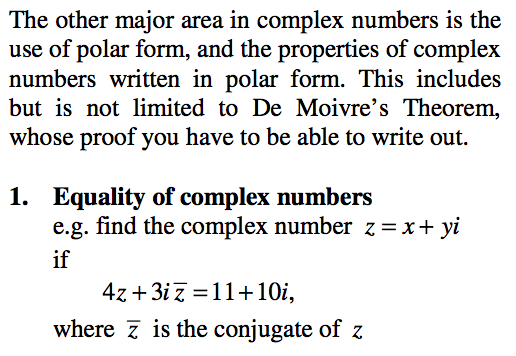
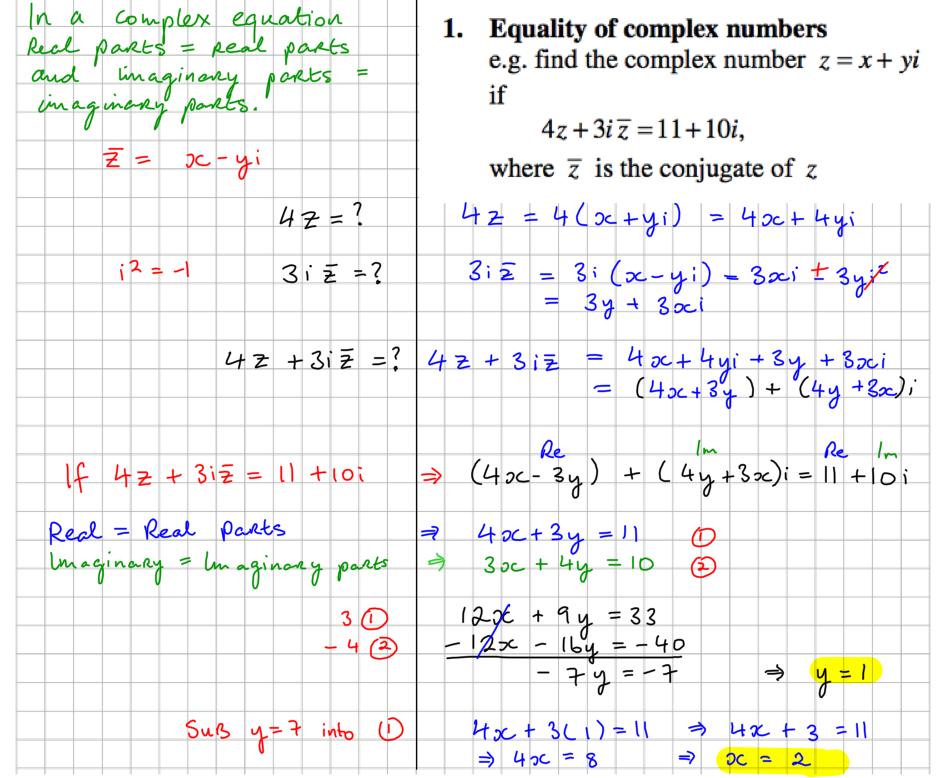
1. Equality of complex numbers

Find the complex number \(z=x+yi\) if \(5z+2i\overline{z}=11-4i\), where \(\overline{z}\) is the conjugate of \(z\).

Show solutionHide solution
Let \(z=x+yi\Rightarrow \overline{z}=x-yi\). Then \[ 5z+2i\overline{z}=5(x+iy)+2i(x-iy)=(5x+2y)+i(2x+5y). \] Equate with \(11-4i\): \(\;5x+2y=11,\;2x+5y=-4\). Solving gives \(x=3,\;y=-2\). Hence \(\boxed{z=3-2i}\).

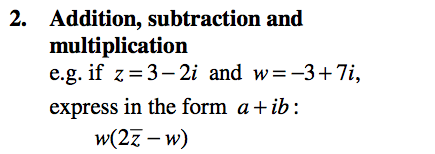
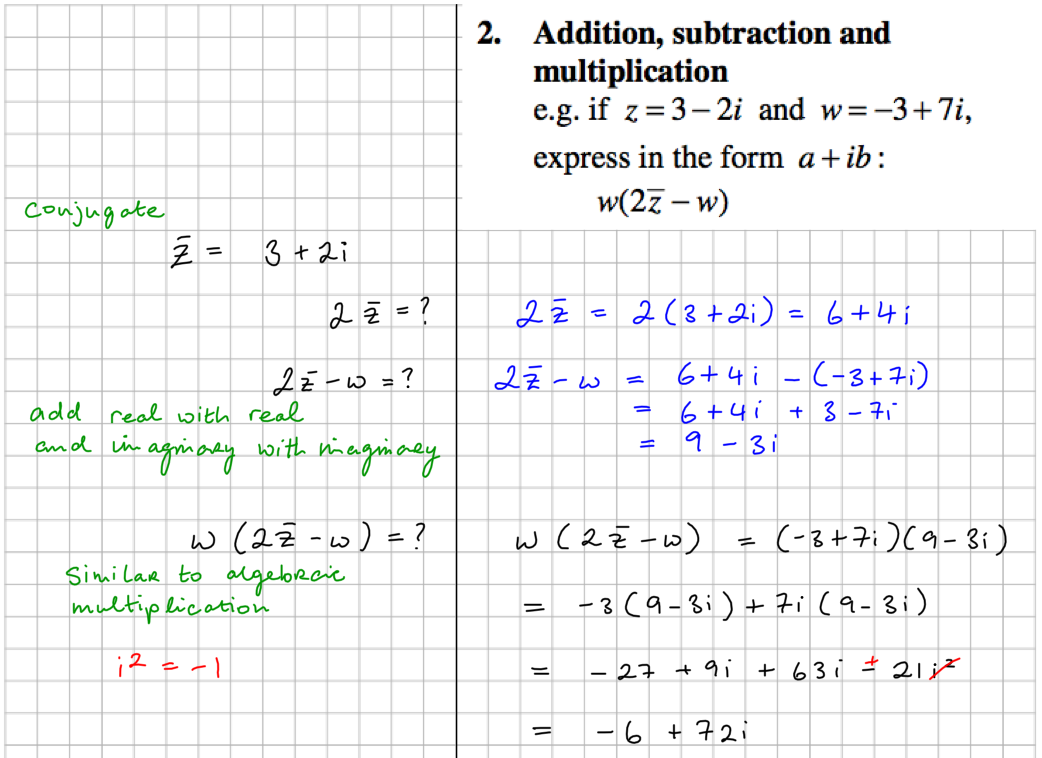
2. Addition, subtraction and multiplication

If \(z=5-3i\) and \(w=-2+4i\), express in the form \(a+bi\): \[ 3w\big(2z-\overline{z}\big). \]

Show solutionHide solution
\(\overline{z}=5+3i\Rightarrow 2z-\overline{z}=5-9i\). Also \(3w=-6+12i\). \((-6+12i)(5-9i)=-30+54i+60i-108i^2=78+114i\). Hence \(\boxed{78+114i}\).

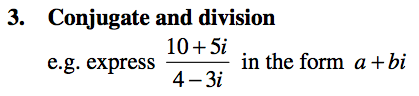
3. Conjugate and division

Express \(\displaystyle \frac{30+i}{3+5i}\) in the form \(a+bi\).

Show solutionHide solution
Multiply top and bottom by \(3-5i\): \[ \frac{(30+i)(3-5i)}{(3+5i)(3-5i)}=\frac{95-147i}{34} =\boxed{\frac{95}{34}-\frac{147}{34}i}. \]

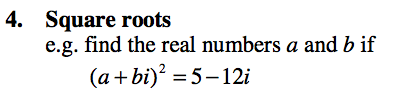
4. Square roots

Find real \(a,b\) if \((a+bi)^2=3-4i\).

Show solutionHide solution
\((a+bi)^2=(a^2-b^2)+2abi=3-4i\Rightarrow a^2-b^2=3,\;2ab=-4\). With \(b=-2/a\): \(a^2-\frac{4}{a^2}=3\Rightarrow a^4-3a^2-4=0\). Let \(t=a^2\): \(t^2-3t-4=0\Rightarrow t=4\). So \(a=\pm2,\;b=\mp1\). Roots: \(\boxed{2-i}\) and \(\boxed{-2+i}\).

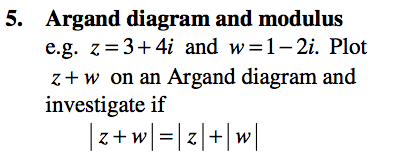
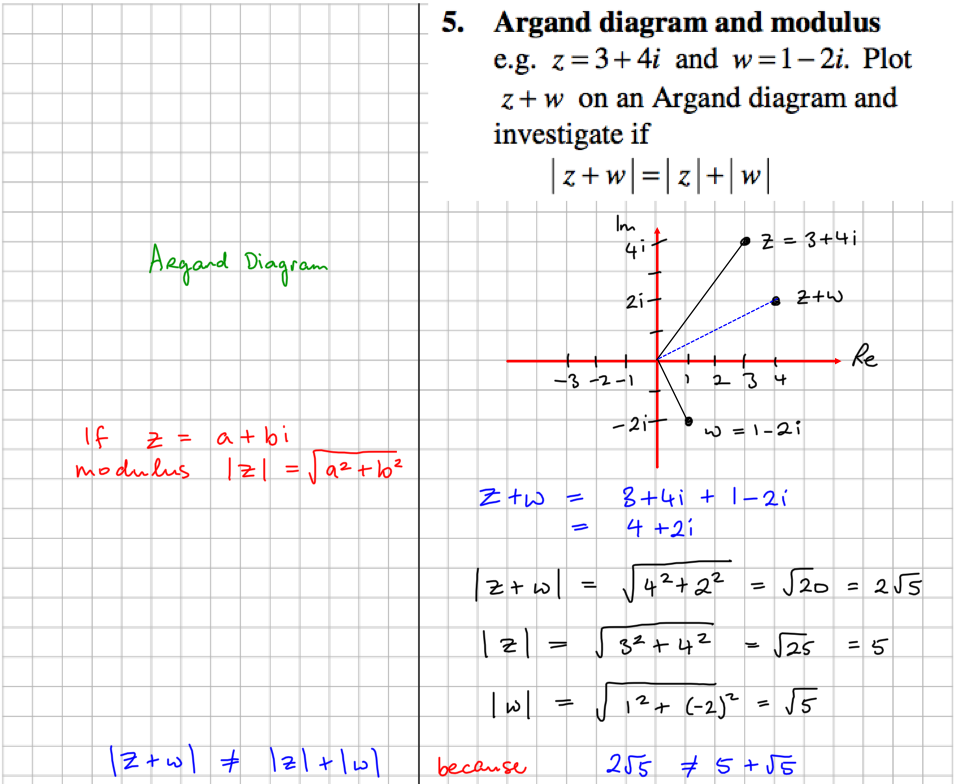
5. Argand diagram and modulus

Let \(z=3+4i\) and \(w=1-2i\). Compute \(z+w\) and investigate whether \(|z+w|=|z|+|w|\).

Show solutionHide solution
\(z+w=4+2i\Rightarrow |z+w|=\sqrt{4^2+2^2}=2\sqrt5\approx4.472.\) \(|z|=5,\;|w|=\sqrt5\approx2.236\Rightarrow |z|+|w|\approx7.236.\) Hence \(|z+w|<|z|+|w|\) (strict), consistent with the triangle inequality.

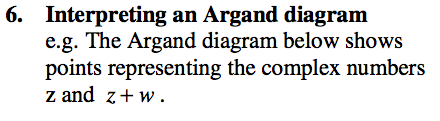
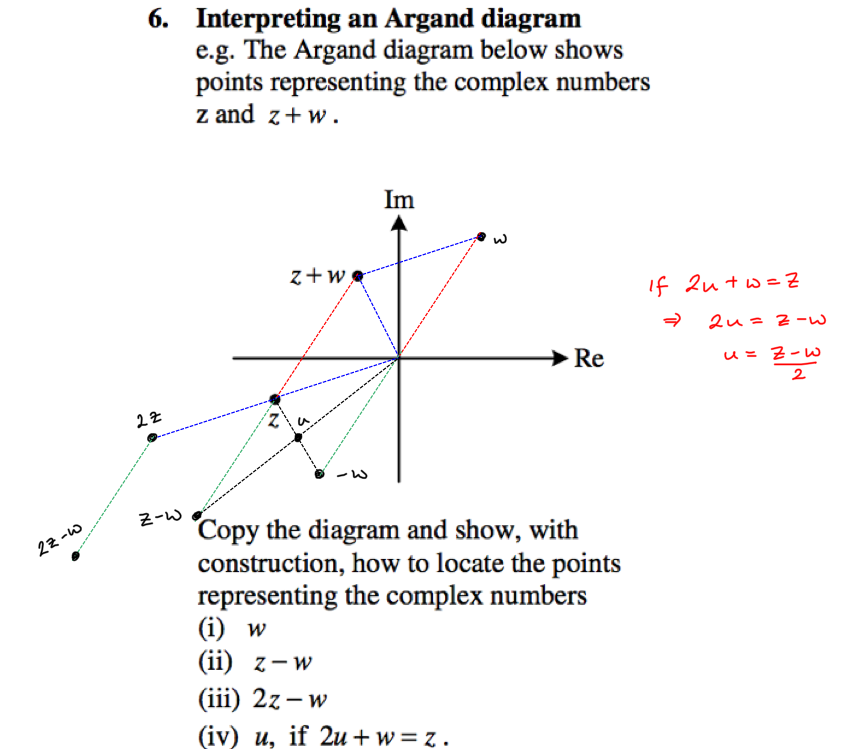
6. Interpreting an Argand diagram

The Argand diagram below shows points \(a,b,c,d,e,f\). They represent \(z,\;2z,\;\overline{z},\;z+\overline{z},\;iz,\; (1+i)z\) .
(i) Identify the label for each of \(z,\;2z,\;\overline{z},\;iz,\;z+\overline{z},\;(1+i)z\). (ii) Determine the acute angle z, O, (1+i)z.

Argand diagram with points a–f
Show solutionHide solution

Identification rules.

  • \(2z\): same argument as \(z\); modulus doubled (lies on same ray, twice as far).
  • \(\overline{z}\): reflection of \(z\) in the real axis.
  • \(iz\): rotation of \(z\) by \(+90^\circ\) (same modulus).
  • \(z+\overline{z}\): real part is doubled, imaginary parts add to 0.
  • \((1+i)z\): multiply by \(1+i=\sqrt2\,\mathrm{cis}(\pi/4)\) → scale by \(\sqrt2\) and rotate \(+45^\circ\).

Angle at \(O\). Multiplication by \(1+i\) rotates any vector by \(\arg(1+i)=45^\circ\). Thus \(\angle z, O,\,(1+i)z=\boxed{45^\circ}\) for any \(z\neq 0\).

Complex number Label on diagram
\(z\)c
\(2z\)e
\(\overline{z}\)b
\(iz\) a
\(z+\overline{z}\)f
\((1+i)z\)d

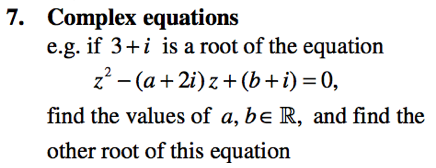
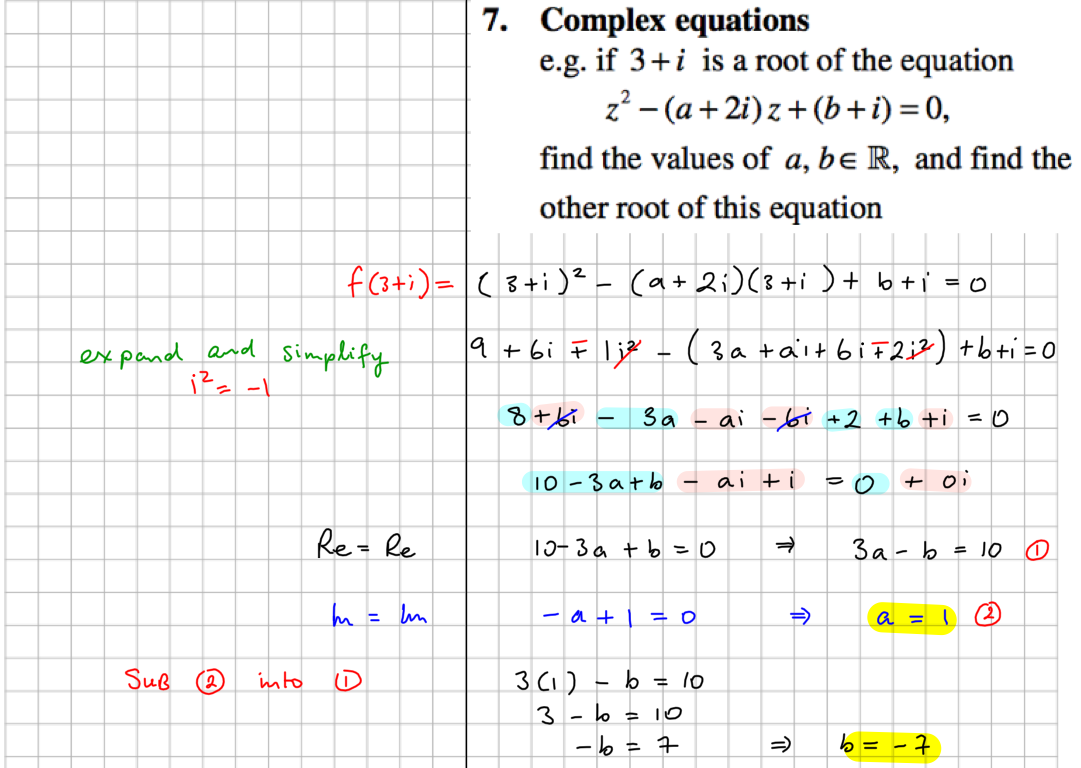
7. Complex equations

If \(2+i\) is a root of \(z^2-(a-i)z+(8+bi)=0\) with \(a,b\in\mathbb{R}\), find \(a,b\) and the other root.

Show solutionHide solution
Let roots be \(z_1=2+i\) and \(z_2\). Sum \(z_1+z_2=a-i\Rightarrow z_2=a-2-2i\). Product \(z_1z_2=8+bi\): \[ (2+i)(a-2-2i)=(2a-2)+(a-6)i. \] Hence \(2a-2=8\Rightarrow a=5\); then \(b=a-6=-1\). Thus \(z_2=3-2i\). \(\boxed{a=5,\;b=-1,\; \text{other root } 3-2i}.\)

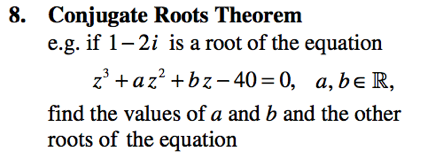
8. Conjugate Roots Theorem

Suppose \(3+2i\) is a root of \(z^3+az^2+bz-52=0\) with \(a,b\in\mathbb{R}\). Find \(a,b\) and the other roots.

Show solutionHide solution
With real coefficients, \(3-2i\) is also a root. Let the third root be \(r\in\mathbb{R}\). Product of roots \(=(3+2i)(3-2i)r=13r=-(-52)=52\Rightarrow r=4\). Sum of roots \(=-(a)=(3+2i)+(3-2i)+4=10\Rightarrow a=-10\). Pairwise sum \(=b=13+4(3+2i)+4(3-2i)=13+24=37\). Hence \(\boxed{a=-10,\;b=37;\; \text{roots } 3\pm2i,\;4.}\)

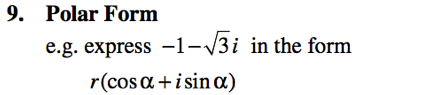
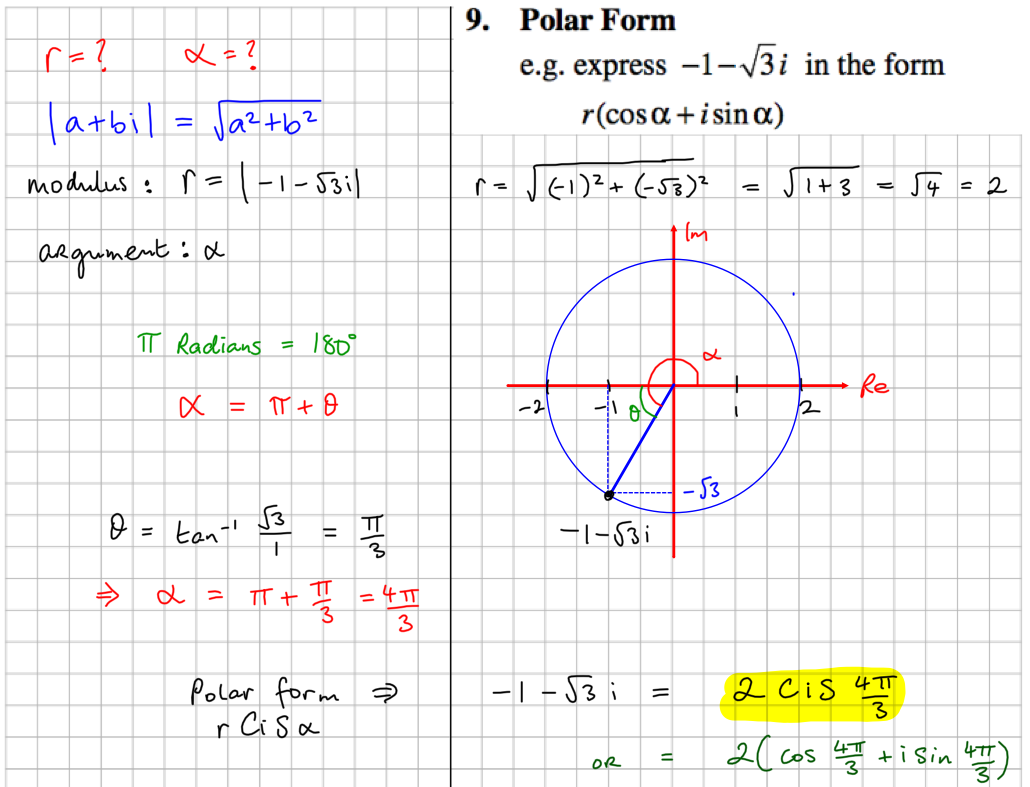
9. Polar form

Express \(-2\sqrt3+2i\) in the form \(r(\cos\alpha+i\sin\alpha)\).

Show solutionHide solution
\(r=\sqrt{(2\sqrt3)^2+2^2}=4\). \(\tan\alpha=\dfrac{2}{-2\sqrt3}=-\dfrac1{\sqrt3}\). With \(x<0,y>0\) (QII), \(\alpha=\pi-\frac{\pi}{6}=\frac{5\pi}{6}\). Hence \(\boxed{4\big(\cos\frac{5\pi}{6}+i\sin\frac{5\pi}{6}\big)}\).

10. De Moivre: Trigonometric identity

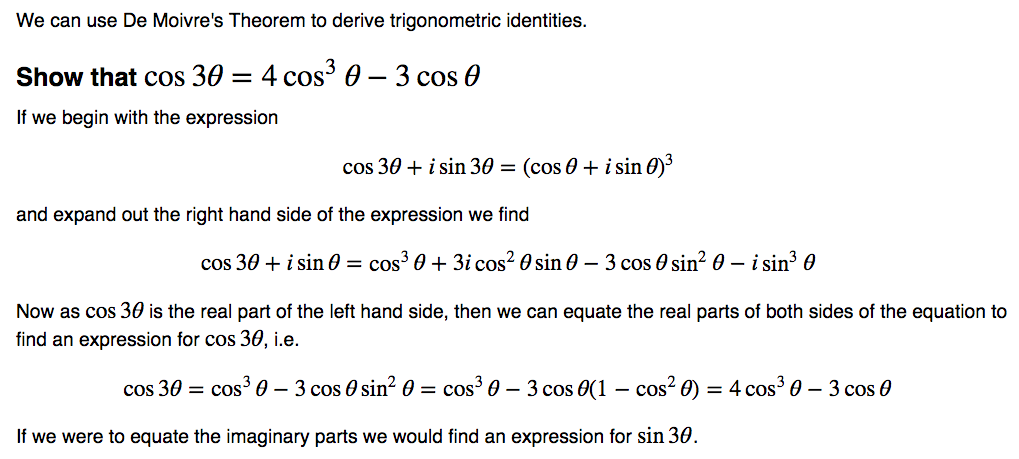
Using De Moivre’s Theorem, express \(\sin 3\theta\) as a polynomial in \(\sin\theta\).

Show solutionHide solution
\((\cos\theta+i\sin\theta)^3=\cos3\theta+i\sin3\theta\). Expand and compare imaginary parts: \[ \boxed{\sin3\theta=3\sin\theta-4\sin^3\theta}. \]

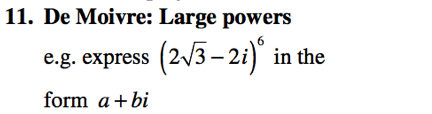
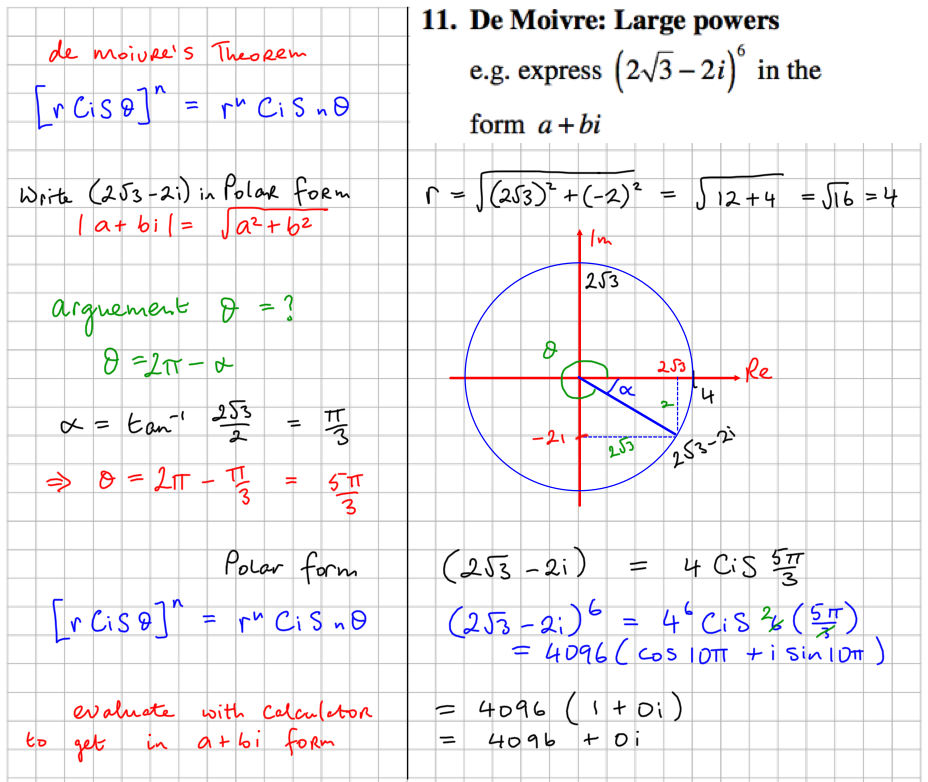
11. De Moivre: Large powers

Express \(\big(1-\sqrt3\,i\big)^8\) in the form \(a+bi\).

Show solutionHide solution
\(1-\sqrt3\,i=2\big(\cos(-\tfrac{\pi}{3})+i\sin(-\tfrac{\pi}{3})\big)\). \[ 2^8\mathrm{cis}(-\tfrac{8\pi}{3}) =256\,\mathrm{cis}(-\tfrac{2\pi}{3}) =\boxed{-128-128\sqrt3\,i}. \]

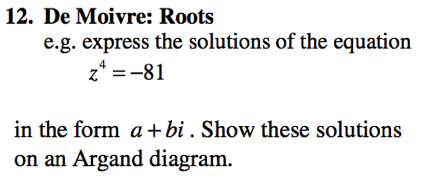
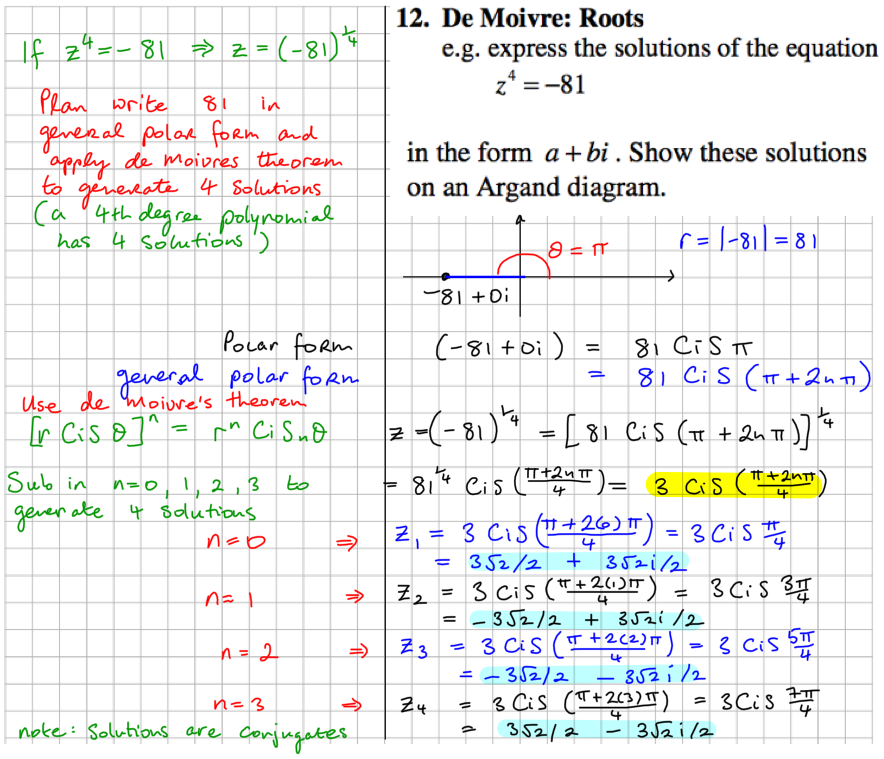
12. Roots via De Moivre

Solve \(z^3=-64\) and give the roots in \(a+bi\) form.

Show solutionHide solution
\(-64=64\,\mathrm{cis}(\pi)\). The roots are \[ z_k=4\,\mathrm{cis}\!\Big(\frac{\pi+2\pi k}{3}\Big),\quad k=0,1,2, \] i.e. \(\boxed{2+2\sqrt3\,i},\ \boxed{-4},\ \boxed{2-2\sqrt3\,i}.\)

1. Irrational numbers

Irrational numbers​ - surds

Construct root 2

Using a compass and straight edge

Construct root 3

Using a compass and straight edge

2. Complex numbers introduction

Equation with imaginary roots

Quadratic equation with imaginary roots

Using the quadratic formula

Addition and multiplication of complex numbers 


3. Division and equity of complex numbers

Dividing by a complex number - conjugate

Expressing a fraction with a real denominator

Complex number equations

"Real = real, imaginary = imaginary"

4. Argand diagram - modulus

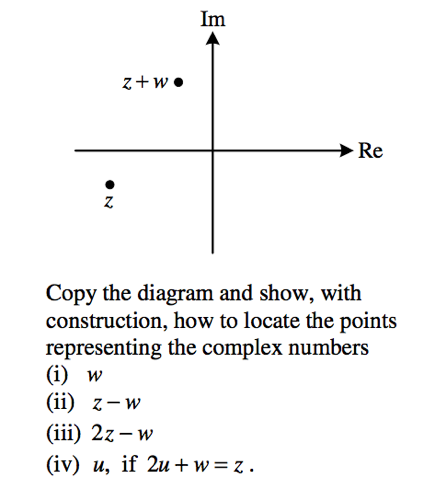
Plot on an Argand diagram
Calculate modulus


5. Transformations of complex numbers

Understanding multiplication

Multiplication involves scaling and rotating
​Addition involves shifting

Transformations involving multiplication


​6. Conjugate roots theorem

Quadratic equation - conjugate roots

Showing that a conjugate is a root

Solving a cubic equation with two imaginary roots


7. Polar form of a complex number

Converting from polar to rectangular form

Express in polar form

Finding the modulus and argument

8. Products and quotients in polar form

Multiplying and dividing in polar form

Multiplication: Multiply the module and add the arguments
Division: Divide the module and subtract the arguments

9. De Moivre's Theorem

Raising a number to a power - expanding

Express in polar form and expand


10. Applications of de Moivre's Theorem

Raising a number to a power

Proving trigonometric identities using de Moivre's Theorem

Finding roots


12 Revision Questions

Complex Number Revision Questions
Picture
Picture
Picture
1. Solution
Picture
2. Solution
Picture
3. Solution
Picture
4. Solution
Picture
5. Solution
Picture
Picture
6. Solution
Picture
7. Solution
Picture
8. Solution
Picture
9. Solution
Picture
10. Solution
Picture
11. Solution
Picture
12. Solution

Picture

Revision Notes

Complex Number Video
Powers of i
KA Powers of i
KA Complex Numbers and i
Introduction to Complex Numbers: Addition, subtraction, multiplication, powers of i.
KA Adding & Subtracting Complex Numbers
KA Multiplying Complex Numbers
Complex division in rectangular form
KA Dividing Complex Numbers
Solving Complex Equations:
 
Real parts = Real parts
Imaginary parts = Imaginary parts
Graphing complex numbers on an Argand diagram and finding the modulus of a complex number.
KA Argand Diagram (Complex Plane)
KA Modulus (Absolute Value) of a Complex Number
Transformations in the Complex Plane
Complex conjugate roots
Solving quadratic and cubic equations with imaginary roots.
Writing a complex number in Polar Form
Multiplying and dividing in Polar Form and using deMoivre's Theorem to expand a complex number to a power.

Using deMoivre's Theorem to find roots of a Complex Equation. 
Using deMoivre's Theorem to prove Trigonometric identities. This question also requires use of the Binomial Theorem.

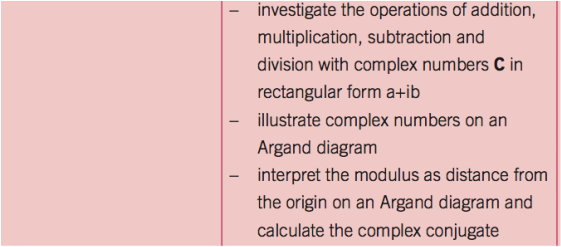
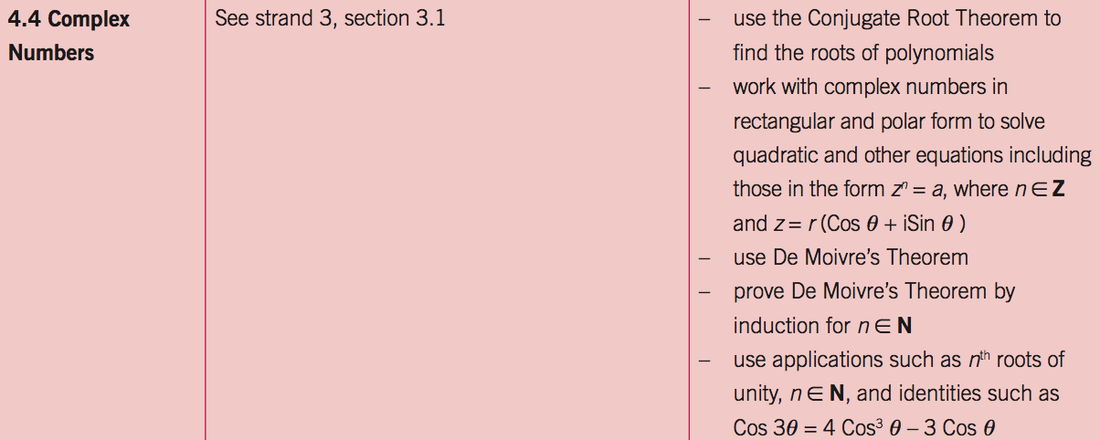
The Syllabus

Picture
3.1 Ordinary & Higher Levels
Picture
4.1 Higher Levels

Abraham de Moivre (1667–1754)

Portrait of Abraham de Moivre

Abraham de Moivre was a French mathematician best known for De Moivre’s Theorem, which links complex numbers and trigonometry through powers of \(\cos\theta + i\sin\theta\). Forced to leave France, he lived most of his life in London and became associated with Newton and Halley. His work in probability and complex numbers remains foundational in modern mathematics.

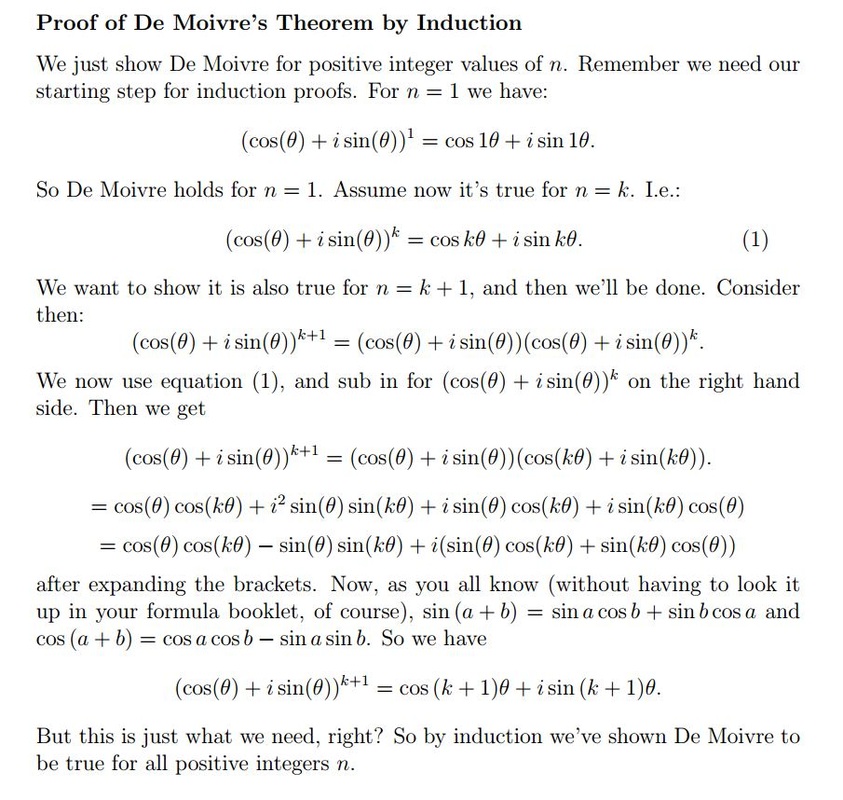
De Moivre’s Theorem

Induction proof for positive integers \(n\)
▸

Theorem. For \(n \ge 1\) and real \(\theta\),

\[ (\cos\theta + i\sin\theta)^n = \cos(n\theta) + i\sin(n\theta). \]

Base case \(n = 1\). We have \((\cos\theta + i\sin\theta)^1 = \cos\theta + i\sin\theta = \cos(1\theta) + i\sin(1\theta)\), so the result holds for \(n=1\).

Induction hypothesis. Assume for some integer \(k \ge 1\) that

\[ (\cos\theta + i\sin\theta)^k = \cos(k\theta) + i\sin(k\theta). \tag{1} \]

Induction step. Then

\[ (\cos\theta + i\sin\theta)^{k+1} = (\cos\theta + i\sin\theta)(\cos(k\theta) + i\sin(k\theta)). \]

Expanding and using \(i^2=-1\),

\[ \begin{aligned} (\cos\theta + i\sin\theta)^{k+1} &= \cos\theta\cos(k\theta) - \sin\theta\sin(k\theta) \\ &\quad {}+ i\bigl(\cos\theta\sin(k\theta) + \sin\theta\cos(k\theta)\bigr). \end{aligned} \]

By the angle–addition formulae, \(\cos(a+b)=\cos a\cos b-\sin a\sin b\) and \(\sin(a+b)=\sin a\cos b+\cos a\sin b\), with \(a=\theta\), \(b=k\theta\), this is

\[ \cos((k+1)\theta) + i\sin((k+1)\theta). \]

Conclusion. The theorem holds for \(n=1\), and if it holds for \(n=k\) it holds for \(n=k+1\). By induction, De Moivre’s theorem is true for all integers \(n \ge 1\).

Powered by Create your own unique website with customizable templates.