eMaths.ie
  • Home
    • Contact
    • Revision Notes
    • 150 HL Revision Questions
    • Exam Layout
    • T&T Solutions
    • Calculators
    • Geogebra
    • Formulae and Tables Book
    • Applied Maths
    • Projectmaths.ie
  • HL Paper 1
    • Algebra 1
    • Algebra 2
    • Algebra 3
    • Financial Maths
    • Algebra Overview
    • Proof by Induction
    • Functions
    • Graphing Polynomials
    • Differentiation
    • Integration
    • Sequences & Series
    • Arithmetic and Money
    • Number Systems
    • Complex Numbers
    • Paper 1 - Must Learn
  • HL Paper 2
    • The Line
    • Probability
    • Statistics
    • Geometry
    • Area and Volume
    • The Circle
    • Trigonometry Overview
    • Trigonometry 1
    • Trigonometry 2
    • Paper 2 - Must Learn
  • HL Exam Papers
    • Printable Exam Questions
    • Exam Question Solutions & Marks
    • Molloy Maths LCHL Exam Videos
    • Revision Questions
  • OL Topics
    • OL Algebra
    • OL Complex Numbers
    • OL Calculus
    • OL Normal Curve and Hypothesis Testing
    • OL Statistics
    • OL Probability
    • OL Area & Volume
    • OL Trigonometry
    • OL Circle

Geometry

PDF Revision Notes
Revision Notes Page

Euclid (c. 325–265 BC)

Portrait of Euclid

Euclid, often hailed as the “Father of Geometry,” wrote Elements, the definitive compilation of ancient geometry. His postulates underpin plane geometry, straight lines, circles and triangles — all fundamental to the Leaving Certificate syllabus. Euclid’s logical approach and proofs set the standard for rigorous mathematics.

Key Geometry Terms — Logic & Proof

Theorem
A statement proven to be true using logical reasoning.
Proof
A logical sequence demonstrating that a theorem is true.
Axiom
A fundamental truth accepted without proof.
Corollary
A result that follows easily from a theorem.
Converse
A statement formed by reversing hypothesis and conclusion.
Implies
If one statement is true, another must logically follow.
Equivalent
Two statements are logically identical; each implies the other.
If and only if
True both ways: A ⇔ B.
Proof by contradiction
Assume the opposite of the statement and show it leads to a contradiction.

Geometry Theorems 11–13

Back to top ↑

Theorem 11

If three parallel lines cut off equal segments on one transversal, then they cut off equal segments on any other transversal.

Given

\(AD \parallel BE \parallel CF\) and \(|AB| = |BC|\).

To prove

\(|DE| = |EF|\).

Construction

  • Draw \(AE'\parallel DE\).
  • Draw \(F'B'\parallel AB\).

Proof

\(ABF'B'\) is a parallelogram ⇒ \(|B'F'|=|AB|\).

Given \(|AB|=|BC|\), so \(|B'F'|=|BC|\).

Parallel lines give angle equalities ⇒ \(\triangle ABE' \cong \triangle F'B'E'\) (ASA).

Thus \(|AE'| = |F'E'|\).

Parallelograms give \(|AE'|=|DE|\) and \(|F'E'|=|EF|\).

Therefore \(|DE|=|EF|\). Q.E.D.

Theorem 12

If a line parallel to \(BC\) cuts \([AB]\) in the ratio \(s:t\), then it cuts \([AC]\) in the same ratio.

Given

Triangle \(ABC\) and \(XY\parallel BC\).

To prove

\(|AY|:|YC| = s:t\).

Construction

  • Divide \([AX]\) into \(s\) equal parts.
  • Divide \([XB]\) into \(t\) equal parts.
  • Draw parallels to \(BC\) through all division points.

Proof

Parallel lines divide \([AC]\) into equal segments (Th. 11).

Let each equal segment be \(k\).

Then \(|AY|=sk\) and \(|YC|=tk\).

Hence \( |AY|:|YC| = sk:tk = s:t \). Q.E.D.

Theorem 13

If triangles \(ABC\) and \(DEF\) are similar, then \[ \frac{|AB|}{|DE|} = \frac{|BC|}{|EF|} = \frac{|AC|}{|DF|}. \]

Given

Triangles \(ABC\) and \(DEF\) are similar.

To prove

\[ \frac{|AB|}{|DE|} = \frac{|BC|}{|EF|} = \frac{|AC|}{|DF|}. \]

Construction

  • Choose \(X \in [AB]\) with \(|AX| = |DE|\).
  • Choose \(Y \in [AC]\) with \(|AY| = |DF|\).
  • Join \(X\) to \(Y\).
Theorem 13 diagram

Proof

\(|AX| = |DE|\) and \(|AY| = |DF|\) by construction.

Similarity gives equal included angles in both triangles.

Thus \(\triangle AXY \cong \triangle DEF\) by SAS.

Corresponding angles are equal, so \(XY \parallel BC\).

Applying Theorem 12: \[ \frac{|AB|}{|AX|} = \frac{|AC|}{|AY|}. \]

Substitute \(|AX| = |DE|\) and \(|AY| = |DF|\): \[ \frac{|AB|}{|DE|} = \frac{|AC|}{|DF|}. \]

Repeating the argument on side \(BC\) gives \(\frac{|BC|}{|EF|} = \frac{|AB|}{|DE|}\).

Therefore \[ \frac{|AB|}{|DE|} = \frac{|BC|}{|EF|} = \frac{|AC|}{|DF|}. \] Q.E.D.

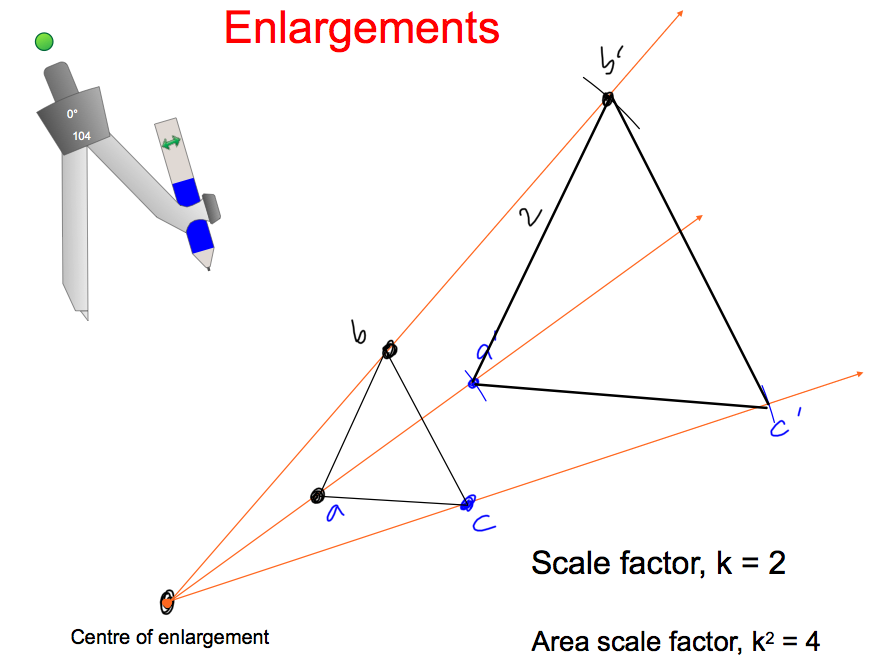
Enlargements

Centre of enlargement · scale factor k · area scale factor k2

Back to top ↑

Key ideas

1. What is an enlargement? An enlargement changes the size of a shape while keeping the shape and angles the same (similar figures).
2. Centre of enlargement
  • The centre of enlargement is a fixed point.
  • Each object point and its image lie on the same ray from this centre.
3. Scale factor k
  • The scale factor k gives the ratio image length ÷ object length.
  • k > 1 → enlargement (bigger).
  • 0 < k < 1 → reduction (smaller).
4. Length and area
  • All lengths multiply by k.
  • All areas multiply by k² (area scale factor).
  • If k = 2, all lengths double and area becomes four times larger.
▶

22 Constructions

Construction Videos
Watch the videos of the 22 geometry constructions 
(click here)
Picture

Use Junior Cert Theorems/Corollaries

There are 21 key ideas on the Junior Cert. Course
Junior Cert Theorems Revision

Use 8 other Theorems/Corollaries

Picture
Picture
Picture
Picture
Picture
Picture
Picture
Picture

Synthetic Geometry Syllabus

Leaving Certificate Syllabus — Geometry

2.1 Synthetic geometry · 2.4 Transformation geometry (enlargements)

Back to top ↑

2.1 Synthetic geometry *

Constructions

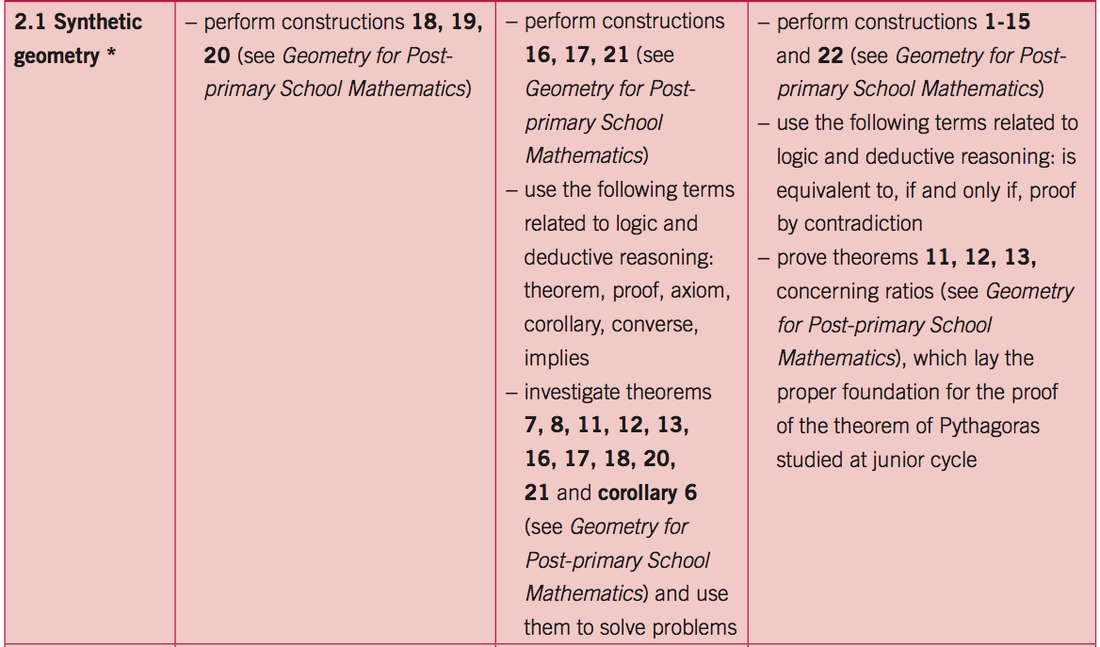
  • Perform constructions 1–22 from Geometry for Post-primary School Mathematics.

Logic and deductive reasoning

  • Use the terms: theorem, proof, axiom, corollary, converse, implies.
  • Also use the terms: is equivalent to, if and only if, proof by contradiction.

Theorems

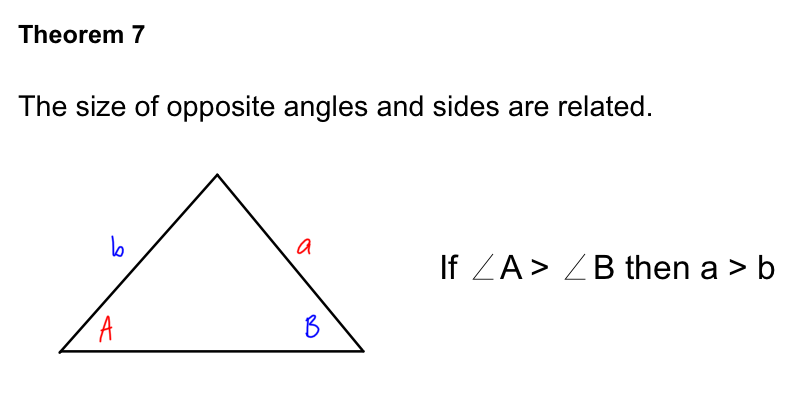
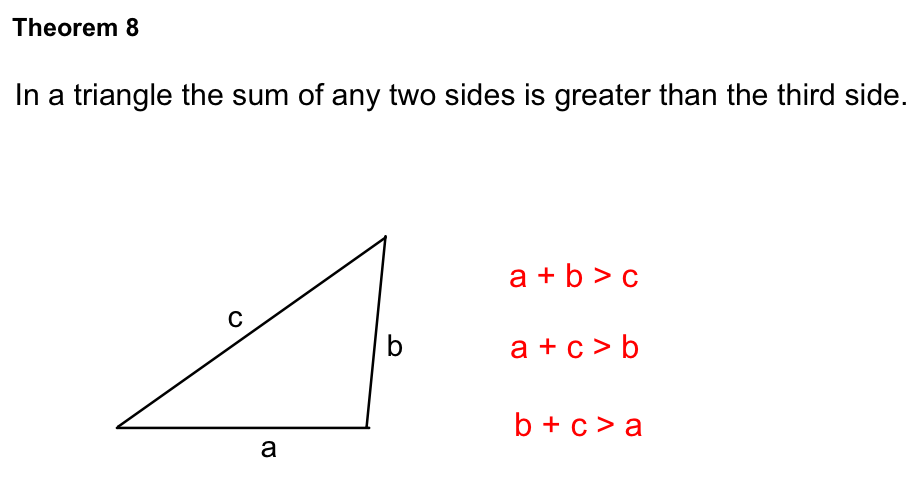
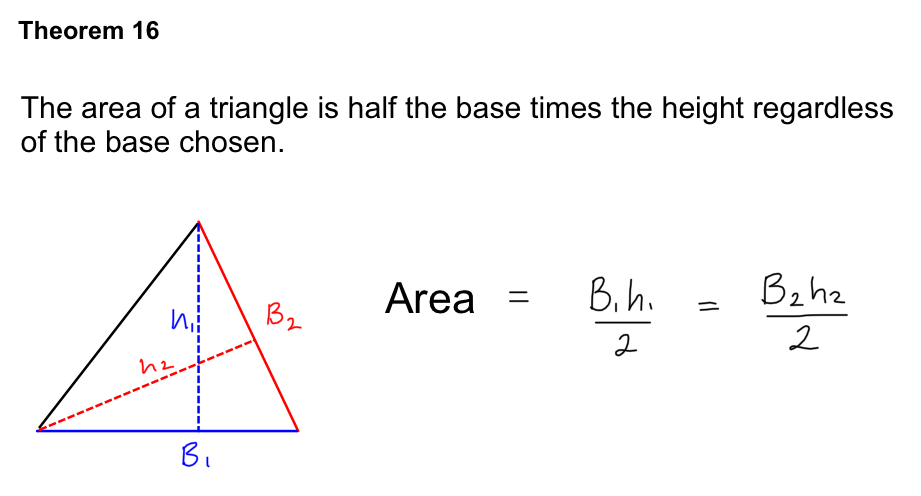
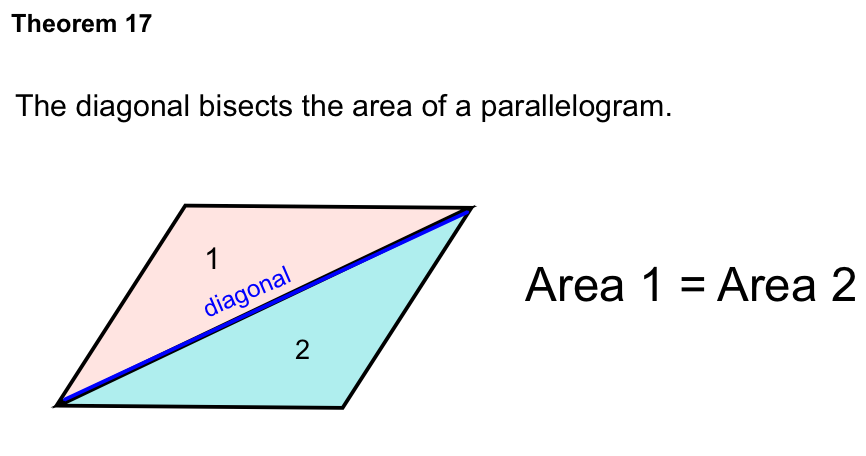
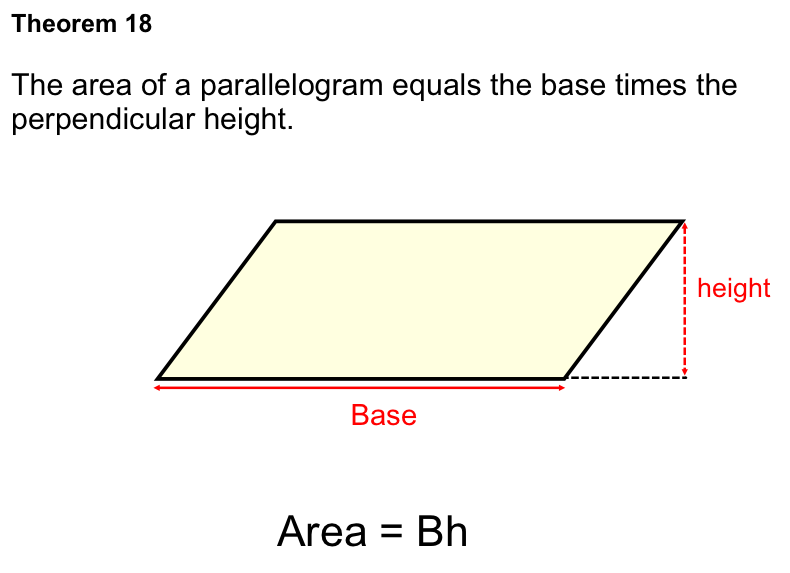
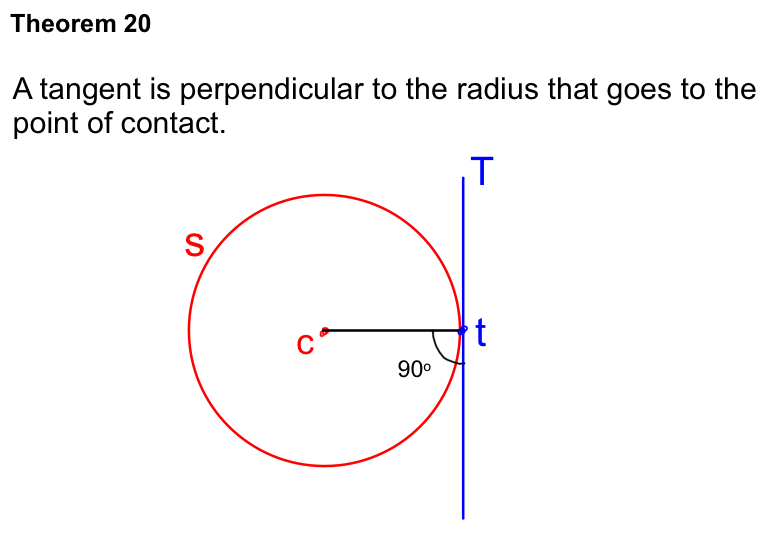
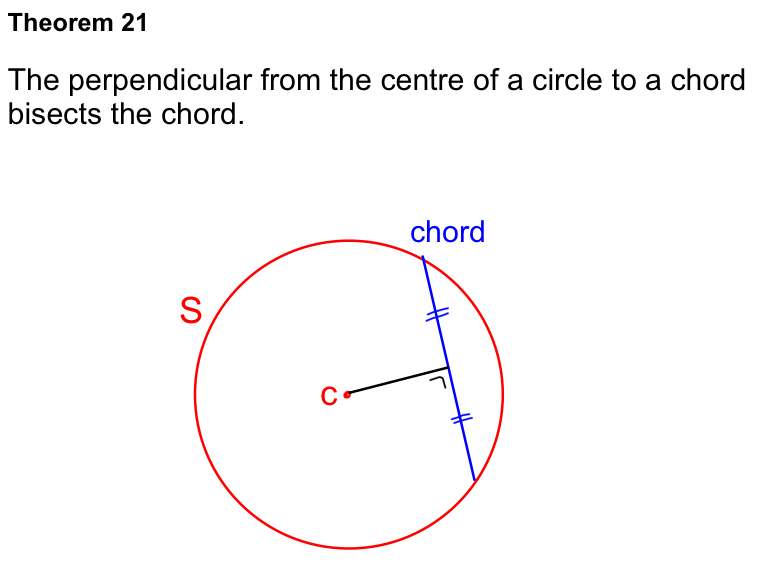
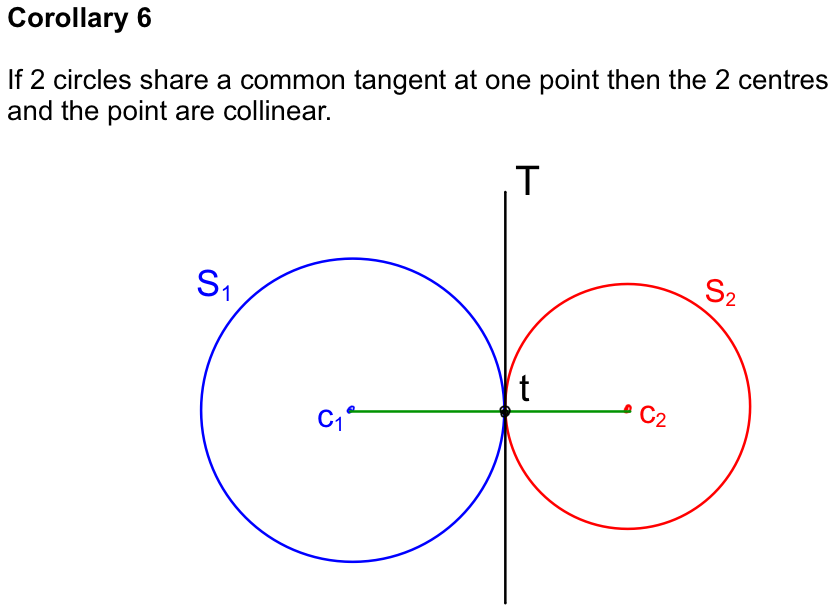
  • Investigate theorems 7, 8, 11, 12, 13, 16, 17, 18, 20, 21 and corollary 6 from Geometry for Post-primary School Mathematics and use them to solve problems.
  • Prove theorems 11, 12, 13 concerning ratios, providing the proper foundation for the proof of the theorem of Pythagoras studied at junior cycle.

2.4 Transformation geometry — enlargements

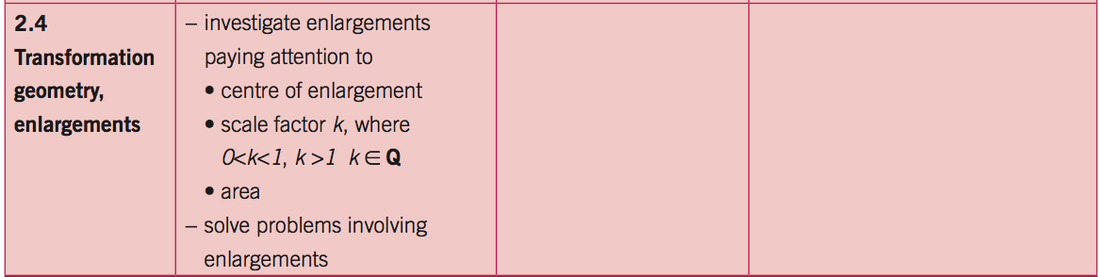
  • Investigate enlargements, paying attention to:
    • centre of enlargement,
    • scale factor k, where 0 < k < 1 or k > 1, with k ∈ ℚ,
    • area.
  • Solve problems involving enlargements.

Geometry for Post-Primary School Mathematics

Your browser does not support viewing this document. Click here to download the document.
Powered by Create your own unique website with customizable templates.