- \(\displaystyle \frac{T}{2\pi}=\sqrt{\frac{l}{g}}\)
- Square both sides: \(\displaystyle \left(\frac{T}{2\pi}\right)^2=\frac{l}{g}\)
- Hence \(\displaystyle l=\frac{gT^2}{4\pi^2}\).
Assume \(g>0\) and \(T>0\).
| eMaths.ie |
|
Expand and simplify: \(7(x^3 + 2x^2 - 5x) - 2(2 + 3x + 4x^2 - 2x^3)\)
Expand and simplify: \((x - 5)(2x^2 - 3x + 6)\)
Given that \(25x^2 + px + 16\) is a perfect square and \(p > 0\), find the value of \(p\).
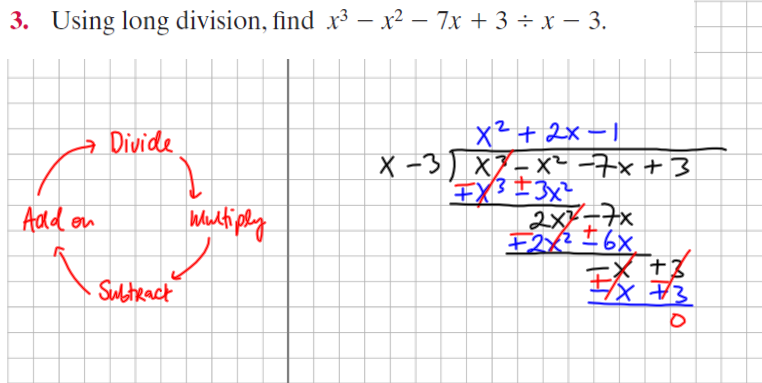
Divide:
(i) \(2x^3 + x^2 - 13x + 6\) by \(x + 3\)
(ii) \(4x^3 - 13x - 6\) by \(x - 2\).
| \(3x^2\) | \(-5x\) | \(-2\) | |
|---|---|---|---|
| \(x\) | \(3x^3\) | \(-5x^2\) | \(-2x\) |
| \(+4\) | \(12x^2\) | \(-20x\) | \(-8\) |
| \(4x\) | \(+3\) | |
|---|---|---|
| \(4x\) | \(16x^2\) | \(12x\) |
| \(+3\) | \(12x\) | \(9\) |
| \(4x\) | \(-3\) | |
|---|---|---|
| \(4x\) | \(16x^2\) | \(-12x\) |
| \(-3\) | \(-12x\) | \(9\) |
| \(2x^2\) | \(+x\) | \(-5\) | |
|---|---|---|---|
| \(x\) | \(2x^3\) | \(x^2\) | \(-5x\) |
| \(-2\) | \(-4x^2\) | \(-2x\) | \(10\) |
The length of a rectangle is \((2x+3)\,\text{cm}\). If the area is \(A(x)=2x^2+7x+6\), find:
(a) an expression for the width, (b) an expression for the perimeter \(P(x)\), (c) the minimum value of \(x\).
A paint manufacturer knows that the daily cost (€ C) of producing \(x\) litres of paint is given by
\(C(x) = 0.001x^2 + 0.1x + 5.\)
(a) State the degree of \(C(x)\).
(b) Find the daily cost of producing (i) 100 ℓ of paint (ii) 400 ℓ of paint.
Given \(f(x) = 3x^3 - 4x^2 - 3x + 4\) and \(g(x) = 5x^3 + 14x^2 + 7x - 2\), find:
(a) \(2f(x) - g(x)\) and state its degree.
(b) \(f(x) + 2g(x)\) and state its degree.
Given the function \(f(x) = 2x - 4\) for all \(x \in \mathbb{R}\), find:
(a) \(f(3)\), \(f(-2)\), \(f(t)\)
(b) For what values of \(t\) is \(f(t) = t\)?
| \(x\) | \(-5\) | |
|---|---|---|
| \(x\) | \(x^2\) | \(-5x\) |
Factorise: (i) \(3x^2+10x+8\) (ii) \(x^2-2\sqrt{2}\,x-6\)
Factorise fully:
(i) \(x^4 - y^4\)
(ii) \(12x^2 - 75y^2\)
| \(3xy\) | \(-6\) | |
|---|---|---|
| \(2x\) | \(6x^2y\) | \(-12x\) |
| \(y\) | \(3xy^2\) | \(-6y\) |
| \(x\) | \(+3y\) | |
|---|---|---|
| \(x\) | \(x^2\) | \(3xy\) |
| \(-3y\) | \(-3xy\) | \(-9y^2\) |
| \(x\) | \(-3\) | |
|---|---|---|
| \(x\) | \(x^2\) | \(-3x\) |
| \(+6\) | \(6x\) | \(-18\) |
Simplify (i) \(\dfrac{5ax}{15a + 10a^2}\) (ii) \(\dfrac{t^2 + 3t - 4}{t^2 - 16}\) (iii) \(\dfrac{\frac{5}{8} + y}{\frac{1}{8}}\)
Simplify each of the following
(i) \(\dfrac{6y}{x(x+4y)} - \dfrac{3}{2x}\) (ii) \(\dfrac{x-4}{x^2 - x - 2} - \dfrac{x-3}{x^2 - 4}\)
Simplify \[ \frac{y - \frac{x^2 + y^2}{y}}{\frac{1}{x} - \frac{1}{y}}. \]
Evaluate (i) \(\binom{7}{4}\) (ii) \(\binom{6}{2}\) (iii) \(\binom{6}{4}\) (iv) \(\binom{15}{4}\)
(i) Find the first 3 terms of the expansion of \((1 - 5y)^8\).
(ii) Find the fourth term of the expansion of \((3a + b)^7\).
| \(x\) | \(+2\) | |
|---|---|---|
| \(x\) | \(x^2\) | \(2x\) |
| \(+2\) | \(2x\) | \(4\) |
Find the values of \(a\) and \(b\) given that \((2x + a)^2 = 4x^2 + 12x + b,\) for all values of \(x.\)
If \(3t^2x - 3px + c - 2t^3 = 0\) for all values of \(x,\) find \(c\) in terms of \(p.\)
Given \[ \frac{1}{(x + 1)(x - 2)} = \frac{A}{(x + 1)} + \frac{B}{(x - 2)}, \] for all values of \(x,\) find the values of \(A\) and \(B.\)
Given that \((x - t)^2\) is a factor of \(x^3 + 3px + c,\) show that \(p = -t^2\) and \(c = 2t^3.\)
\(2x - \sqrt{3}\) is a factor of \(4x^2 - 2(1+\sqrt{3})x + \sqrt{3}\;\); find the second factor.
(i) If \(v^2=u^2+2as\), express \(a\) in terms of \(v\), \(u\) and \(s\).
(ii) If \(\sqrt{\dfrac{x+y}{x-y}}=\dfrac12\), express \(y\) in terms of \(x\). Hence find the value of \(y\) when \(x=5\).
Given \(x=\dfrac{t+4}{3t+1}\), find \(t\) in terms of \(x\).
Assume \(g>0\) and \(T>0\).
Examine each of the following patterns of numbers and determine if there is a
linear or quadratic relationship between the terms. Write an algebraic expression for each set of numbers:
(a) \(-2, 1, 4, 7, \dots\)
(b) \(3, 5, 11, 21, \dots\)
Solve the linear equation \(\dfrac{2t-3}{5}+\dfrac{1}{20}=\dfrac{t-1}{4}.\)
Solve the equations \(3x-y=1\) and \(x-2y=-8.\)
Solve the equations \(2x - 5y = 9\) and \(3x + 2y = 4.\)
Solve the simultaneous equations:
A: \(x + y + z = 6\)
B: \(2x + y - z = 1\)
C: \(4x - 3y + 2z = 4\).
Solve the following system:
First, eliminate \(z\) using (A) and (B), then using \((C) + 2(A)\).
\[ \text{(A) + (B):} \begin{array}{rcrcrcrl} 2x &+& y &-& z &=& 9 \\[3pt] +~x &+& 2y &+& z &=& 6 \\[3pt] \hline 3x &+& 3y& & &=& 15 \end{array} \Rightarrow x+y=5\quad\text{(D)} \] \[ \text{(C) + 2(A):} \begin{array}{rcrcrcrl} 3x &-& y &+& 2z &=& 17 \\[3pt] +~4x &+& 2y &-& 2z &=& 18 \\[3pt] \hline 7x &+& y & & &=& 35 \end{array} \Rightarrow 7x+y=35\quad\text{(E)} \]Subtract (D) from (E).
\[ \begin{array}{rcrcrl} 7x &+& y &=& 35 \\[3pt] -~x &-& y &=& -5 \\[3pt] \hline 6x & & &=& 30 \end{array} \Rightarrow x=5 \]
An opera was attended by 240 people. Two ticket prices, €31 and €16, were available.
If the total takings on the night were €5595, find, using this data:
(i) two linear equations connecting the two types of tickets sold
(ii) the number of €31 tickets sold
(iii) the number of €16 tickets sold.
Fifty, twenty and ten cent coins are collected from a coin machine and counted.
The total value of the coins is €32. When counting, the cashier noted that twice
the number of twenty cent coins, added to the number of ten cent coins, equalled
three times the number of fifty cent coins. She then noticed that four times the
number of fifty cent coins, added to the number of ten cent coins, equalled six
times the number of twenty cent coins.
Find the number of each type of coin in the machine.