Coordinate Geometry of the Circle |
The Line - Key Ideas
The Circle - Key Ideas
Coordinate Geometry of the Circle
Section 1: The equation of a circle with centre (0, 0)
|
|
|
Section 2: Equations of circles with centres (h, k) or (-g, -f)
|
|
|
|
|
|
Section 3: Finding the equation of a circle
|
|
|
|
|
|
|
|
Section 4: Tangents to a circle
|
|
|
|
|
|
Section 4: Common Chords or Tangents and Circles intersecting the X or Y-axis
|
|
|
|
|
|
Section 6: Touching circles and chords
|
|
|
Section 7: Circles touching an axis
|
|
HL 2025 – Question 7 (c) Submarine & Circles
Part (c) – 30 marksA submarine is within \(\sqrt{58}\,\text{km}\) of a point \(A\) and within \(\sqrt{178}\,\text{km}\) of a point \(B\). The distance from \(A\) to \(B\) is \(20\text{ km}\). The points \(A(0,0)\) and \(B(20,0)\) are shown. Circle \(k\) has centre \(A(0,0)\) and radius \(\sqrt{58}\). Circle \(s\) has centre \(B(20,0)\) and radius \(\sqrt{178}\). The submarine lies in the shaded region \(R\), which is inside both circles.
The points \(C\) and \(D\) are intersections of the circles. The point \(C\) is \((7,3)\) and the point \(D\) is \((7,-3)\).
(i) & (ii) Equation of circle \(s\) and verification
(i) Write down the equation of circle \(s\).
(ii) By using your answer to part (a)(i), or otherwise, verify that \((7,3)\) lies on circle \(s\).
Solution (c)(i)&(ii)
Circle \(s\) has centre \(B(20,0)\) and radius \(\sqrt{178}\). Using \((x-h)^2 + (y-k)^2 = r^2\), its equation is \[ (x-20)^2 + y^2 = 178. \]
To verify that \(C(7,3)\) lies on \(s\), substitute \(x=7\), \(y=3\): \[ (7-20)^2 + 3^2 = (-13)^2 + 9 = 169 + 9 = 178. \] The result equals \(178\), so \((7,3)\) satisfies the equation and therefore lies on circle \(s\).
Full credit (10): correct equation \((x-20)^2 + y^2 = 178\) and verification \((7-20)^2 + 3^2 = 178\) or equivalent reasoning.
High partial (7): one part fully correct and work of merit in the other part (for example, identifies centre and radius, or substitutes \(x=7,y=3\) with an arithmetic slip).
Mid partial (5): one part correct ((i) or (ii)) or work of merit in both parts.
Low partial (3): work of merit only, e.g. identifies the centre or radius, or partially substitutes into the equation. If circle \(k\) is used instead of \(s\) but the rest is correct, award at most high partial credit.
(iii) Area of triangle \(DBC\)
Using the points \(C(7,3)\) and \(D(7,-3)\), find the area of the triangle \(DBC\), in \(\text{km}^2\).
Solution (c)(iii)
Points: \(B(20,0)\), \(C(7,3)\), \(D(7,-3)\). Segment \(CD\) is vertical, so its length is \[ |3 - (-3)| = 6\ \text{km}. \] Segment \(BC\) is horizontal, with length \[ 20 - 7 = 13\ \text{km}. \] Right-angled triangle with base \(13\) and height \(6\): \[ \text{Area}_{\triangle DBC} = \tfrac12 \times 6 \times 13 = 39\ \text{km}^2. \]
Full credit (5): area \(39\ \text{km}^2\) (accept without unit).
High partial (3): fully substituted area-of-triangle formula but slip in arithmetic.
Low partial (2): work of merit, e.g. writes \(\tfrac12 bh\) with one correct side, or indicates a correct translation before using coordinates.
(iv) Size of angle \(\angle CBD\)
Find the size of the acute angle \(\angle CBD\), correct to the nearest degree.
Solution (c)(iv) — Method 1
In \(\triangle DBC\), point \(B\) is at \((20,0)\) and \(C(7,3)\), \(D(7,-3)\) are symmetric about the \(x\)-axis. The right triangle \(BCO\) (with \(O\) the foot from \(C\) to the \(x\)-axis) has \[ \tan\angle CBA = \frac{3}{13}. \] So the acute angle between \(BC\) and the \(x\)-axis is \[ \tan^{-1}\!\left(\frac{3}{13}\right)\approx 12.95^\circ. \] Angle \(\angle CBD\) is twice this (above and below the axis): \[ |\angle CBD| = 2\tan^{-1}\!\left(\frac{3}{13}\right) \approx 25.9^\circ \approx 26^\circ. \]
Accept correct answer without unit.
Full credit (5): \(\angle CBD \approx 26^\circ\), using any valid method (double tangent method, sine rule, or cosine rule).
High partial (3): finds a key intermediate result such as \(\tan^{-1}(3/13)\), or correctly sets up \(A = \tfrac12 ab\sin C\) or a cosine-rule expression but does not finish.
Low partial (2): work of merit, e.g. identifies opposite/adjacent sides, or makes a correct substitution into the sine or cosine rule.
If an incorrect area from part (iii) leads to an impossible triangle (e.g. \(\sin\angle CBD > 1\)) but this contradiction is clearly shown, award at most high partial credit.
(v) Area of shaded region \(R\)
The area of the sector \(ADC\) of circle \(k\) is \(23.4837\ \text{km}^2\), correct to 4 decimal places. The area of triangle \(ADC\) is \(21\ \text{km}^2\). Using this, work out the area of the shaded region \(R\) that is inside both circles. Give your answer in \(\text{km}^2\), correct to 2 decimal places.
Solution (c)(v) — Method 1
From part (iv), \(|\angle CBD| \approx 26^\circ\). In circle \(s\) (radius \(\sqrt{178}\)), area of sector \(CBD\) is \[ A_{\text{sector }CBD} = \frac{26}{360}\,\pi(\sqrt{178})^2 = \frac{26}{360}\,\pi(178) \approx 40.3869\ \text{km}^2. \]
Area of triangle \(DBC\) (from part (iii)) is \(39\ \text{km}^2\). So the small lens in circle \(s\) is \[ A_{\text{sector }CBD} - A_{\triangle DBC} \approx 40.3869 - 39 \approx 1.3869\ \text{km}^2. \]
In circle \(k\), the portion inside both circles is \[ A_{\text{sector }ADC} - A_{\triangle ADC} = 23.4837 - 21 = 2.4837\ \text{km}^2. \]
Total shaded region \(R\) (inside both circles) is \[ A_R \approx 1.3869 + 2.4837 \approx 3.8706 \approx 3.87\ \text{km}^2 \] correct to 2 decimal places.
Consider four main steps:
Step 1: Writes a correct formula for the sector \(CBD\). Step 2: Finds the numerical area of this sector. Step 3: Finds at least one area of “sector minus triangle” (for \(CBD\) or \(ADC\)). Step 4: Finds the required total shaded area.
Full credit (10): all four steps correct giving \(A_R \approx 3.87\ \text{km}^2\) (accept without unit; apply * for incorrect rounding).
High partial (7): three steps correct.
Mid partial (5): two steps correct.
Low partial (3): work of merit, e.g. correct substitution into a sector formula, or correctly finds the area of sector \(CBD\) or of sector \(ADC\) minus triangle \(ADC\).
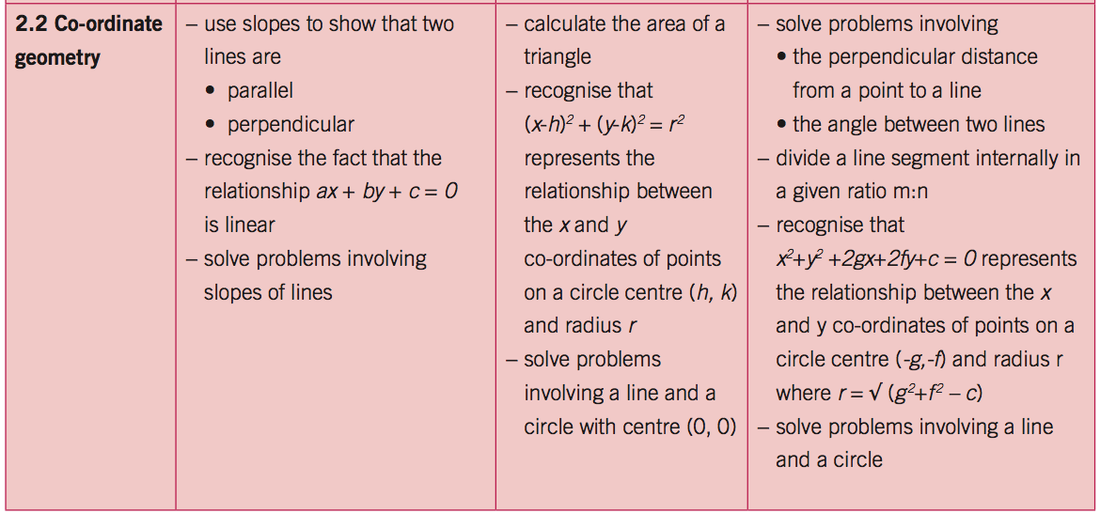
Co-ordiante Geometry Syllabus
Coordinate Geometry of the Circle — Syllabus
- Recognise that \( (x-h)^{2} + (y-k)^{2} = r^{2} \) represents the relationship between the \(x\)- and \(y\)-coordinates of points on a circle with centre \((h,k)\) and radius \(r\).
- Recognise that \( x^{2} + y^{2} + 2gx + 2fy + c = 0 \) represents the relationship between the coordinates of points on a circle with centre \((-g,-f)\) and radius \( r = \sqrt{g^{2} + f^{2} - c} \).
- Solve problems involving a circle with centre \((0,0)\).
- Solve problems involving a line and a circle.