Algebra 2 — Key Learning Outcomes Checklist
□ High Priority — “Not Yet”
□ Medium Priority — “Need Practice”
□ Maintain — “Confident”
- A quadratic equation has the form \( ax^2+bx+c=0 \), where \(a,b,c\in\mathbb{R}\) and \(a\ne0\).
- There are always two roots in \( \mathbb{C} \) (distinct real, repeated real, or complex conjugate).
- Methods of solution:
- Factorisation.
- Quadratic formula \( x=\dfrac{-b\pm\sqrt{b^2-4ac}}{2a} \).
- Completing the square.
- Substitution (e.g. to remove surds) when appropriate.
- Graphical methods (the \(x\)-intercepts of the parabola \(y=ax^2+bx+c\)).
Solving Quadratic Equations by Factorising
(i) \(x^{2} - 5x - 6 = 0\)
(ii) \(y^{2} - 5y = 0\)
(iii) \(4t^{2} - 100 = 0\)
Show video
Show worked solution
Worked Example: Solving \(3x^{2}+10x-8=0\) by Factorising (Area Model)
▼
Use the area-model with guide number \(-24x^{2}\) to produce \((3x-2)(x+4)=0\); hence \(x=\tfrac{2}{3}\) or \(x=-4\).
Solving Equations Involving Fractions
Show video
Show worked solution
Solving Quadratic Equations with Substitution
Show video
Show worked solution
Solving a Quadratic Surd Equation using Substitution
Show video
Show worked solution
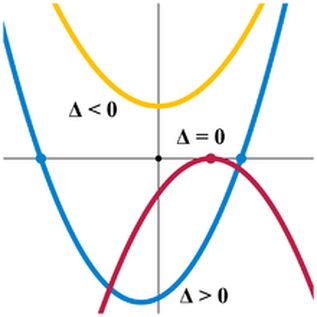
- The discriminant of \( ax^2 + bx + c = 0 \) is \( \Delta = b^2 - 4ac \).
- The discriminant determines the nature of the roots:
- \( \Delta > 0 \): two distinct real roots.
- \( \Delta = 0 \): one repeated real root.
- \( \Delta < 0 \): two complex conjugate (non-real) roots.
- If \( \Delta \) is a perfect square, the roots are rational; if \( \Delta > 0 \) but not a perfect square, the roots are irrational (but real).
Using the Discriminant to Find the Nature of Quadratic Roots
(a) \(3x^{2}+5x-1=0\) (b) \(49x^{2}+42x+9=0\)
(c) \(2x^{2}+8x+9=0\) (d) \(2x^{2}+7x+4=0\)
Recall the discriminant: \(\Delta=b^{2}-4ac\) for \(ax^{2}+bx+c=0\).
-
(a) \(a=3,\; b=5,\; c=-1\).
\(\Delta=5^{2}-4(3)(-1)=25+12=37>0\).
Two distinct real roots (irrational). -
(b) \(a=49,\; b=42,\; c=9\).
\(\Delta=42^{2}-4(49)(9)=1764-1764=0\).
Two identical real roots (a repeated root). -
(c) \(a=2,\; b=8,\; c=9\).
\(\Delta=8^{2}-4(2)(9)=64-72=-8<0\).
No real roots. -
(d) \(a=2,\; b=7,\; c=4\).
\(\Delta=7^{2}-4(2)(4)=49-32=17>0\).
Two distinct real roots.
Irish specification connection: discriminant determines the number and nature of roots and whether the quadratic graph cuts the \(x\)-axis (two, one, or zero intercepts).
Problem Involving Equal Roots
Proving Roots are Reals and Rational
(i) Show that the roots are real for all \(p,q\in\mathbb{R}\).
(ii) Show that the roots simplify to rational expressions in \(p\) and \(q\) (hence are rational numbers whenever \(p,q\in\mathbb{Q}\)).
(iii) Hence find (a) the roots in terms of \(p,q\); (b) the factors in terms of \(p,q\).
- A simultaneous system may include one quadratic and one linear equation in two variables.
- The solutions correspond to the intersection points of the parabola (quadratic) and the line (linear).
- Methods of solution:
- Substitution: express one variable from the linear equation and substitute into the quadratic.
- Elimination: eliminate one variable to obtain a single equation in the other when convenient.
- The number of real solutions (0, 1, or 2) depends on how the line meets the parabola.
Quadratic–Linear Simultaneous Equations (Points of Intersection)
(i) \(x-y=-1\) (ii) \(x-y=3\).
Quadratic–Linear Simultaneous: No Real Intersection
- Algebraic methods can be used to solve many real-life problems.
- When an unknown quantity can be represented by a variable and the relationship written as a linear or quadratic equation, the resulting equation can be solved using known algebraic techniques.
- Typical contexts include geometry (perimeter, area, or Pythagoras), motion, and intersection problems (e.g. a line meeting a circle or parabola).
Quadratic & Linear Simultaneous Equations — Context Problem
(i) an equation (in \(x\) and \(y\)) for the perimeter,
(ii) an equation (in \(x\) and \(y\)) for the hypotenuse,
(iii) solve to find possible lengths of the base \(x\) and height \(y\).
Line & Circle — Will the Paths Cross?
- If \( \alpha \) and \( \beta \) are the roots of a quadratic, the equation can be written as \( (x-\alpha)(x-\beta)=0 \).
- Expanding gives \( x^2-(\alpha+\beta)x+\alpha\beta=0 \).
- Hence:
- Sum of roots \( \alpha+\beta=-\tfrac{b}{a} \)
- Product of roots \( \alpha\beta=\tfrac{c}{a} \)
- If only the sum \(S\) and product \(P\) of the roots are known, the quadratic equation is \( x^2-Sx+P=0 \).
Key Concept — Forming a Quadratic Equation from its Roots
Given roots \(r_1\) and \(r_2\), the quadratic equation can be written as:
\(x^{2} - (r_{1} + r_{2})x + r_{1}r_{2} = 0\)
\(x^{2} - (\text{sum of the roots})x + (\text{product of the roots}) = 0\)
Forming an Equation from Given Roots
Finding Coefficients from Given Roots
Quadratic from Given Roots
- Any quadratic can be written in vertex form \(y=a(x-h)^2+k\) by completing the square.
- The vertex is \((h,k)\); the axis of symmetry is \(x=h\).
- If \(a>0\), the parabola opens upwards and has a minimum value \(k\) at \(x=h\); if \(a<0\), it opens downwards and has a maximum value \(k\) at \(x=h\).
- Completing the square for \(ax^2+bx+c\) gives \[ ax^2+bx+c = a\!\left(x+\frac{b}{2a}\right)^{\!2} + c - \frac{b^{2}}{4a}. \]
- Sign/roots connection (using discriminant \(\Delta=b^2-4ac\)):
- If \(a>0\) and \(\Delta<0\), then \(ax^2+bx+c>0\) for all \(x\).
- If \(a<0\) and \(\Delta<0\), then \(ax^2+bx+c<0\) for all \(x\).
Completing the Square — An Introduction
Finding the Minimum Value of a Quadratic
(i) find the minimum point and minimum value of \(x^{2}+4x+1\);
(ii) solve \(x^{2}+4x+1=0\) leaving your answers in surd form.
Quadratic from a Graph (Vertex form → Standard form)
(ii) By choosing any suitable point on the curve, find \(a\).
(iii) Hence write the equation in the form \(~y=ax^{2}+bx+c\).
- A surd is an irrational root (e.g. \( \sqrt{2},\sqrt{5} \)) that cannot be expressed exactly as a fraction.
- Surds are left in exact form unless a decimal approximation is required.
- Rules:
- \( \sqrt{a}\times\sqrt{b}=\sqrt{ab},\qquad \dfrac{\sqrt{a}}{\sqrt{b}}=\sqrt{\dfrac{a}{b}} \)
- Simplify \( \sqrt{a^2b}=a\sqrt{b} \) only when \( a>0 \).
- Rationalise denominators by multiplying by a suitable form of 1 to remove the surd from the denominator.
Simplifying Surds
(ii) Express \((4 - \sqrt{5})^{2}\) in the form \(b + c\sqrt{5}\), where \(b\) and \(c\) are integers.
Simplifying Surd Fractions (Dividing by Surds)
(i) \(\dfrac{\sqrt{12}}{5\sqrt{3} - \sqrt{27}}\)
(ii) \(\dfrac{7}{\sqrt{13} - \sqrt{11}}\)
- To solve equations containing surds, first isolate a square root, then square both sides.
- Domain matters: ensure each radicand is non-negative and respect any sign conditions introduced (e.g. a side declared non-negative).
- Squaring can introduce extraneous solutions; always check in the original equation.
- Useful identities:
- \( \sqrt{a}\sqrt{b}=\sqrt{ab}, \quad \dfrac{\sqrt{a}}{\sqrt{b}}=\sqrt{\dfrac{a}{b}} \) for \(a,b\ge0,\ b\ne0\)
- \( \sqrt{a^2b}=a\sqrt{b} \) for \(a\ge0\)
- Rationalise denominators by multiplying by a conjugate, e.g. \( \dfrac{1}{p+q\sqrt{r}} \cdot \dfrac{p-q\sqrt{r}}{p-q\sqrt{r}} \).
Key Concept — Solving Surd Equations
For one surd:
- Isolate the surd term.
- Square both sides to remove the square root.
- Solve the resulting equation and check each solution.
For two surds:
- Isolate one surd on one side first.
- Square both sides to remove that surd.
- Simplify — you’ll still have one surd left.
- Isolate and square again to remove the second surd.
- Solve and verify every solution by substitution.
Rule of thumb: isolate → square → simplify → repeat → check.
Solving a Surd Equation and Verifying Solutions
For \(x=3:\) LHS \(=3,\) RHS \(=\sqrt{3+6}=\sqrt{9}=3\) ✓ valid.
For \(x=-2:\) LHS \(=-2,\) RHS \(=\sqrt{-2+6}=\sqrt{4}=2\) ✗ not valid.
Solving an Equation with Two Surd Terms (and Verifying)
\(x=2:\ \sqrt{16}-\sqrt{4}=4-2=2\ \checkmark\)
\(x=\dfrac{2}{9}:\ \sqrt{\dfrac{64}{9}}-\sqrt{\dfrac{4}{9}}=\dfrac{8}{3}-\dfrac{2}{3}=2\ \checkmark\)
- Remainder Theorem: For a polynomial \(f(x)\), the remainder on division by \(x − a\) is \(f(a)\).
- Factor Theorem: \(x − a\) is a factor of \(f(x)\) iff \(f(a)=0\).
- Once a linear factor is found, divide to reduce the degree, then factorise the quotient (by inspection, completing the square, or using the quadratic formula).
- Strategy for integer roots: test \(\pm\) factors of the constant term (or \(\pm\) factors of \(\tfrac{\text{constant}}{\text{leading coefficient}}\) for non-monic polynomials).
Key Concept — The Factor Theorem
If f(k) = 0, then (x − k) is a factor of f(x).
Conversely, if (x − k) is a factor, then f(k) = 0.
More generally, if (a x − k) is a factor, then f( k ⁄ a ) = 0.
Using the Factor Theorem
\[ 2\!\left(\tfrac{3}{2}\right)^{3}-5\!\left(\tfrac{3}{2}\right)^{2} +5\!\left(\tfrac{3}{2}\right)-3 =\tfrac{27}{4}-\tfrac{45}{4}+\tfrac{15}{2}-3 =\tfrac{27-45+30-12}{4}=0. \] Hence \(f\!\left(\tfrac{3}{2}\right)=0\) and by the Factor Theorem \((2x-3)\) is a factor.
Using the Factor Theorem to Find Unknown Coefficients
Factorising Cubic Expressions
Solving a Cubic Equation
- A polynomial of degree \( n \) has the form \( f(x)=a_nx^n+a_{n-1}x^{n-1}+\cdots+a_1x+a_0 \), where \( a_n\ne0 \).
- Zeros (roots) \( r_1,r_2,\dots \) satisfy \( f(r_i)=0 \); the factorised form is \( f(x)=a(x-r_1)(x-r_2)\cdots(x-r_n) \).
- To find a polynomial from its roots and a known point, substitute the point to determine the leading coefficient \( a \).
- Graphs of higher-degree polynomials are continuous and smooth; the number of real roots corresponds to the number of \(x\)-intercepts.
Key Concept — Finding a Polynomial from its Graph
The roots of a polynomial tell you where the graph cuts or touches the x-axis.
The function can be written as a multiple of its factors:
\(f(x) = k(x - r_1)(x - r_2)(x - r_3)\dots\)
The constant \(k\) (the scale factor) can be found by substituting a known point on the graph, e.g. \((x_0, y_0)\).
Finding an Expression for a Cubic Polynomial from its Graph
Finding the Expression for a Degree-4 Polynomial from its Graph
Find the values of \(a,b,c,d\).
Extra Practice Questions
Solution.
The general cubic with these roots is \( f(x) = a(x-1)(x-2)(x-3) \).
Substitute \( (4, 24) \): \( 24 = a(3)(2)(1) \Rightarrow a = 4 \).
Hence \( f(x) = 4(x-1)(x-2)(x-3) \).
Solution.
The general quadratic is \( f(x) = a(x+1)(x-3) \).
Substitute \( (0, -6) \): \( -6 = a(1)(-3) \Rightarrow a = 2 \).
Therefore \( f(x) = 2(x+1)(x-3) \).